
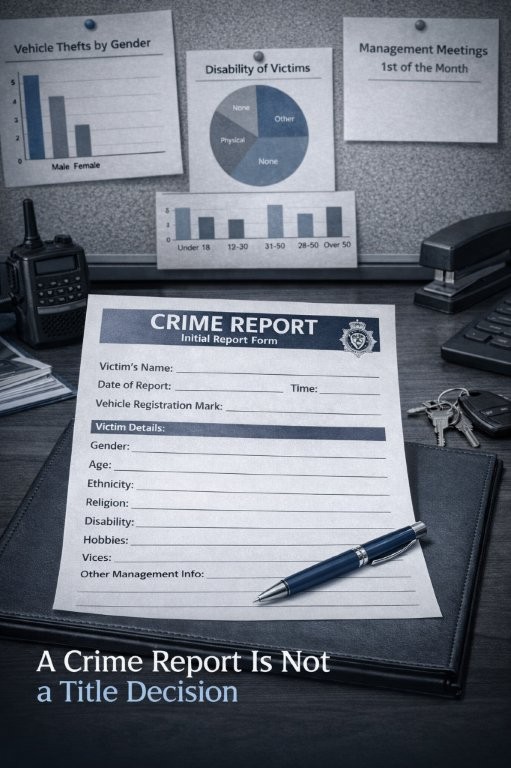
When a vehicle is reported stolen, most people assume the legal position is straightforward: the vehicle belongs to the person who reported it stolen, and anyone found in possession of it must simply surrender it. In reality, the situation can be far more complicated.
A police crime report records an allegation of theft, but it is not a judicial determination of ownership or title. That distinction becomes critically important when a vehicle is later recovered from an innocent purchaser who bought the vehicle in good faith and may have paid thousands of pounds for it.
This article introduces the central theme of this series: the difference between recording a crime and deciding ownership rights.
Police constabularies record reports of crime in order to ensure allegations are documented and investigated*. However, the administrative act of recording a theft report does not automatically establish legal ownership in any subsequent dispute.
*the extent to which this occurs can vary considerably by constabulary and crime type
When a vehicle is recovered months later from a buyer who had no knowledge of the original theft, the situation evolves from a policing matter into a question of property rights, possession and fairness.
The purpose of this article and those that will follow, is to explain why these issues are frequently misunderstood and why the consequences of that misunderstanding can be severe for innocent purchasers.
The starting point is the crime report itself. Under the Home Office crime recording framework, police must record notifiable offences when credible information suggests a crime has occurred. The threshold for recording is intentionally low. The aim is to ensure that potential crimes are not ignored or filtered out at an early stage.
However, recording an allegation is not the same as proving that allegation.
At the time the report is made, police will often have limited information. In many cases, the only evidence available is the account provided by the person reporting the vehicle as stolen. That account may later prove to be entirely correct. But the crime recording process itself is not designed to determine questions of civil ownership or legal title.
The distinction becomes important when a vehicle is later found.
In some cases, a recovered vehicle will still be in the possession of the person who stole it. In those situations the outcome is usually straightforward. But in many other cases the vehicle may have passed through several hands before being recovered.
A buyer may have purchased the vehicle from a trader or private seller, paid market value, and completed the transaction believing it was entirely legitimate. That buyer may have taxed, insured and maintained the vehicle, only to discover later that the vehicle had previously been reported stolen.
At that point, the issue is no longer simply whether a theft was reported. The real question becomes: what should happen now that competing claims to the vehicle exist?
Unfortunately, the existence of a stolen marker can sometimes create the impression that this question has already been answered. In reality, the recording of a theft allegation and the determination of ownership rights are two very different legal matters.
This series will explore how that distinction affects innocent purchasers, police practice and the wider system of vehicle recovery.
The Series
To follow over the next weeks:
- 11/03/2026 – A Crime Report Is Not a Title Decision
- 13/03/2025 – The Innocent Purchaser: The Forgotten Victim in Vehicle Recovery
- 17/03/2026 – Who helps the Innocent?
- Should the Original Police Force Normally Handle the Innocent Purchaser’s Crime?
- Police Powers to Seize Are Not Powers to Decide Ownership
- Do Police Hand Vehicles Over Too Quickly?
- The Police (Property) Act: A Route Many People Never Hear About
- Insurers Often Examine More Than the Police
- Theft to Recovery: The Longer the Gap, the Harder the Truth
- Trackers Do More Than Recover Cars
- The Badge, the Buyer and the Power Imbalance
- Good Faith Is Not Enough
- The Inexpensive Check That May Save Thousands
- What Better Practice Would Look Like
Next post – ‘2’
Reference & Relevant
- The Devalued Crime Report
- Crime Number Devaluation
- Crime Recorded ≠ Crime Verified
- Crime Reports – Duplication
- ‘taking him at his word, they (the police) issued a crime reference number‘
- When Recorded Theft Is Not Believed
- L.I.E. – When Taking is not Theft: The Hidden Cost of Misreported Vehicle Crimes – Car Crime U.K.
- Vehicle Theft Surge Demands Police Action on Crime Report Disclosures
Legislation – potentially relevant
Sale of Goods Act 1979, section 21: the basic nemo dat rule – a seller who is not the owner generally cannot pass better title than he has.
Consumer Rights Act 2015, section 17: where goods are supplied by a trader, the contract includes a term that the trader has the right to sell or transfer them; useful for the innocent purchaser’s civil remedies against the seller.
Torts (Interference with Goods) Act 1977: relevant to conversion and civil disputes over wrongful interference with goods; legislation commentary expressly uses the example of a good-faith buyer of a stolen car being sued by the true owner.
Police (Property) Act 1897, section 1: magistrates’ court power to order delivery of property in police possession to the person appearing to be the owner, or otherwise make such order as seems fit.
Criminal Procedure Rules 2025, rule 47.37: procedural mechanism for applications under the Police (Property) Act.
Police and Criminal Evidence Act 1984, section 19, and Theft Act 1968, section 26: police powers relevant to seizure/search of suspected stolen goods.
Human Rights Act 1998, Article 1 of Protocol 1: protects possessions and supports proportionality/procedure arguments where property is withheld or transferred.
Further case law and information can be found here
Website Disclaimer
The information provided on this website is for general informational and research purposes only. While we strive to ensure that all content is accurate, up to date, and relevant, laws and regulations are constantly evolving. As such, the information presented may not reflect the most current legal standards or interpretations.
Nothing on this website should be construed as legal advice or a substitute for professional legal counsel. If you require legal assistance or advice specific to your circumstances, you should consult a qualified lawyer.
We accept no responsibility or liability for any errors, omissions, or inaccuracies in the content, nor for any reliance placed upon the information provided. The use of this website and its content is entirely at your own risk.
By continuing to use this website, you acknowledge and agree to these terms.