
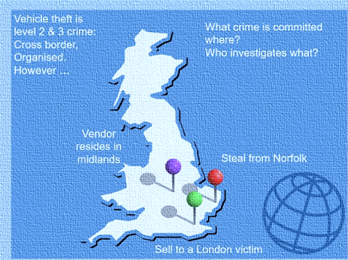
Should the Original Police Force Normally Handle the Innocent Purchaser’s Crime?
When a stolen vehicle is recovered from an innocent purchaser, responsibility for dealing with that purchaser’s position is often unclear. In some cases the buyer is directed to report fraud elsewhere or pursue civil remedies independently. Yet the innocent purchaser’s situation arises directly from the same chain of events that began with the original theft report.
For that reason, the police force that recorded the theft is arguably often the authority best placed to investigate the full timeline and address the issues that arise when the vehicle is later recovered. It is, after all, the initial constabulary’s crime but … it will likely be argued (assuming the subject is raised) that the innocent purchaser was duped, defrauded, elsewhere, within the jurisdiction of another police service. Furthermore, the purchaser was subject to FRAUD … a complicated, resource-heavy offence; they can be directed to ActionFraud, now ‘Report Fraud‘.
This article examines a practical problem within vehicle recovery cases: who should investigate the innocent purchaser’s position once a recovered vehicle is identified?
Currently, the response can be inconsistent. The purchaser may be referred elsewhere or encouraged to pursue civil action against the seller – assuming they can be identified; as aspect that should likely interest law enforcement staff.
While these options may exist, they often detach the purchaser’s problem from the original theft investigation.
The purpose of this article is to argue that, in many cases, the police force that recorded the theft is best placed to examine the entire chain of events — from the reported theft to the eventual recovery of the vehicle. This approach would promote continuity, improve investigative efficiency and ensure that the innocent purchaser’s evidence contributes to understanding what happened to the vehicle after it was taken.
The starting point is the theft report itself.
When a vehicle is reported stolen, the police force receiving the report creates the crime record and becomes responsible for investigating the offence. That force holds the initial account of the theft and the earliest available evidence relating to the vehicle’s disappearance.
If the vehicle later appears hundreds of miles away in the possession of a buyer, the situation becomes part of the same investigative timeline.
From an investigative perspective, the innocent purchaser may provide valuable information about what happened to the vehicle after it was taken. They may know:
- who sold them the vehicle
- where the sale occurred
- how the vehicle was advertised
- what documents were provided
- what communications took place before the purchase
- the payment method
This information could potentially assist in identifying individuals involved in handling or reselling stolen vehicles.
However, if the purchaser is simply redirected into a separate fraud reporting system, that evidence may become disconnected from the original theft investigation. The result is fragmentation.
Instead of a single coherent timeline from theft to recovery, the evidence becomes scattered across multiple reporting routes and jurisdictions.
Assigning responsibility to the original police force would create a clearer investigative structure. That force already holds the theft report and is therefore best positioned to connect the purchaser’s account to the broader investigation. It would also reduce unnecessary administrative duplication and help avoid situations in which innocent purchasers feel they have been passed from one authority to another without meaningful assistance.
The above assumes the police will investigate and assist, that the approach is not simply ‘theft is a negative, recovery is a positive, the balance is restored’
Where does this leave the party or parties between these events?
Should the constabulary that records a vehicle theft normally be responsible for investigating what happens when the vehicle is later found in the hands of an innocent purchaser?
Next post – ‘4’
Reference & Relevant
- The Devalued Crime Report
- Crime Number Devaluation
- Crime Recorded ≠ Crime Verified
- Crime Reports – Duplication
- ‘taking him at his word, they (the police) issued a crime reference number‘
- When Recorded Theft Is Not Believed
- L.I.E. – When Taking is not Theft: The Hidden Cost of Misreported Vehicle Crimes – Car Crime U.K.
- Vehicle Theft Surge Demands Police Action on Crime Report Disclosures
Legislation – potentially relevant
- Sale of Goods Act 1979, section 21: the basic nemo dat rule – a seller who is not the owner generally cannot pass better title than he has.
- Consumer Rights Act 2015, section 17: where goods are supplied by a trader, the contract includes a term that the trader has the right to sell or transfer them; useful for the innocent purchaser’s civil remedies against the seller.
- Torts (Interference with Goods) Act 1977: relevant to conversion and civil disputes over wrongful interference with goods; legislation commentary expressly uses the example of a good-faith buyer of a stolen car being sued by the true owner.
- Police (Property) Act 1897, section 1: magistrates’ court power to order delivery of property in police possession to the person appearing to be the owner, or otherwise make such order as seems fit.
- Criminal Procedure Rules 2025, rule 47.37: procedural mechanism for applications under the Police (Property) Act.
- Police and Criminal Evidence Act 1984, section 19, and Theft Act 1968, section 26: police powers relevant to seizure/search of suspected stolen goods.
- Human Rights Act 1998, Article 1 of Protocol 1: protects possessions and supports proportionality/procedure arguments where property is withheld or transferred.
Further case law and information can be found here
Website Disclaimer
The information provided on this website is for general informational and research purposes only. While we strive to ensure that all content is accurate, up to date, and relevant, laws and regulations are constantly evolving. As such, the information presented may not reflect the most current legal standards or interpretations.
Nothing on this website should be construed as legal advice or a substitute for professional legal counsel. If you require legal assistance or advice specific to your circumstances, you should consult a qualified lawyer.
We accept no responsibility or liability for any errors, omissions, or inaccuracies in the content, nor for any reliance placed upon the information provided. The use of this website and its content is entirely at your own risk.