13. What Better Practice Would Look Like
Are we Looking at the Wrong End of Vehicle Crime?
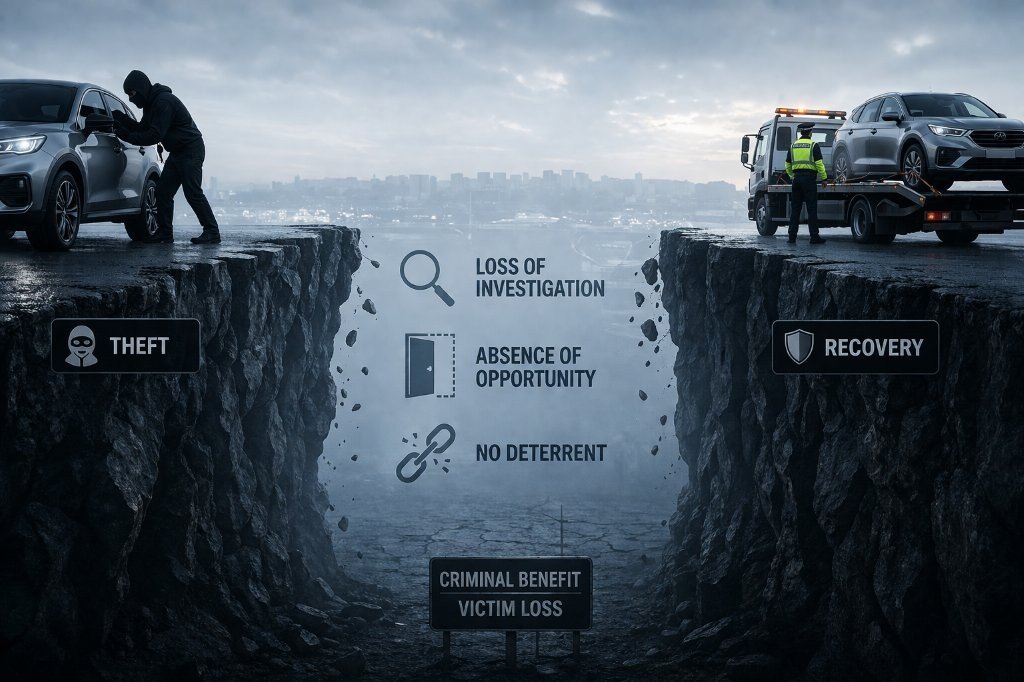
Recovered vehicle cases reveal a wider flaw in how vehicle crime is understood. Public attention naturally focuses on two obvious points:
- the theft report at the beginning
- and the recovery of the vehicle at the end.
Those are the visible moments. But they do not explain where the real criminal success lies, or where the greatest innocent harm occurs. That story sits in the middle. It is in the period between theft and recovery that the vehicle is moved, concealed, re-identified, sold on, passed through hands and ultimately lands with an unsuspecting purchaser.
- This is where organised offenders profit.
- That is where innocent buyers inherit the loss.
And too often, that is the part no one meaningfully investigates.
It should be noted that this series has focused primarily on those recovered vehicle situations where a stolen vehicle, or one alleged to be stolen, has passed into the hands of an unsuspecting purchaser, giving rise to questions of title, possession, police seizure and competing claims.
The vehicle theft environment is broader than this. Many stolen vehicles are retained for criminal use, dismantled for parts, exported, or simply recovered abandoned or parked without an accompanying person.
However, it is in the “sold on” scenario – where criminal profit, innocent purchaser loss and ownership disputes converge – that the practical and legal tensions examined throughout this series are often seen most clearly.
The same absence of backward investigation may, of course, have wider implications beyond these cases.
Theft and recovery are not the full story
Theft is the starting point.
- A report is made.
- A crime is recorded.
- A registration mark may be circulated.
Recovery is the visible ending.
- A vehicle is found.
- Police attend.
- The vehicle is seized or moved on.
These two points create the impression of a complete process:
- something was taken, the -ve,
- something was recovered, the +ve
- the balance is restored
- case closed.
But this can be dangerously misleading. Because what sits between those two events is often where the real activity occurred, by way of examples:
- who handled the vehicle
- where it was stored
- whether it was dismantled or re-identified
- who sold it
- what documentation was created
- who profited from the transaction
- how an innocent purchaser was deceived
This is the very part of the timeline that explains organised vehicle crime. Yet it is often the least examined.
Recovery is not deterrence
There is a tendency to treat the locating of a stolen vehicle, in itself, as a positive outcome. And of course, recovery is better than permanent loss. But recovery alone does not disrupt organised vehicle crime. If a vehicle is simply found, seized and handed on:
- the method is not fully understood
- the handlers are not always identified
- the resale route is not explored
- the profit remains with the offender
Another vehicle can be stolen tomorrow; interference in the ‘supply chain’ is a niggle, an ‘occupational hazard’ for criminals, but the ‘buy low, sell high’ model is less affected when the ‘supplier’ is not paid anything for the goods!
Recovery may interrupt a single incident, but without investigation it does not necessarily deter the criminal enterprise behind it.
That distinction matters. Because a system that measures success by recovery alone may overlook whether anything has actually been prevented.
The two real extremes are often forgotten
There is a natural assumption that the principal parties are:
- the original owner who suffered the theft and
- the insurer that may later become involved.
But the wider picture contains two more significant extremes.
- At one end, the offender who has benefited, profited and often disappeared from view.
- At the other, the innocent purchaser who loses the vehicle, the money, the convenience and often any clear route to assistance.
The offender has extracted value from the process.
The innocent purchaser inherits the consequence.
This is the uncomfortable transfer of harm that recovered vehicle cases can conceal; we see the theft, we see the recovery. Too little attention is given to the criminal success and innocent loss created in between.
The silo problem
Part of the difficulty is structural. There is often an unspoken assumption that:
- the police deal with the theft
- the insurer deals with the claim
- the recovery agent deals with the vehicle
- the innocent purchaser deals with their own loss
Each segment is addressed separately.
Organised vehicle crime is not segmented. It is one continuous chain.
Treating each stage in isolation risks missing the very relationships that matter. This is where “collaboration” needs to become something more than a word. Meaningful collaboration would involve:
- police understanding the civil implications of recovery
- insurers sharing intelligence and theft concerns earlier
- better recording of innocent purchaser details and evidence
- a willingness to investigate backwards from the point of recovery
- public guidance that explains rights, expectations and practical steps
Without that joined-up approach, each participant only sees their aspect of the event. Criminals see the whole picture.
Better public understanding matters too
There is also a public education issue. Motorists need to understand:
- a crime report is not a title decision
- police seizure does not automatically settle ownership
- provenance checks matter
- written purchase receipts matter
- a quick recovery matters and
- innocence alone may not protect title
These are not niche legal concerns. They are practical realities that can determine whether a person loses thousands of pounds.
What better practice should really mean
Better practice is not simply a matter of new forms or internal guidance. It means changing what questions are asked. Not just:
- Was the vehicle stolen?
- Has it been recovered?
But also:
- Who profited in the middle?
- Who handled it?
- Who legitimised it?
- Who was deceived?
- What evidence remains?
- How do we prevent this happening again?
Until those questions become routine, recovered vehicle cases will continue to produce the same pattern:
- criminal benefit,
- innocent purchaser loss, and
- no deterrence.
Observation
We have become conditioned to see theft as the problem and recovery as the solution. Too little attention is given to everything in between, which is where the criminals profit and the innocent purchaser loses.
Perhaps that is the part of vehicle crime we should be looking at far more closely.
Series Closing Note
This series was not intended simply to highlight legal complexity or isolated disputes about recovered vehicles. Its broader purpose has been to encourage thought about whether the current handling of such cases is truly delivering:
- deterrence,
- fairness,
- meaningful investigation, and
- clear public understanding.
Recovered vehicle cases sit at the intersection of criminal conduct, civil ownership rights, insurance interests and consumer loss. They therefore offer a useful lens through which to examine whether the wider response to organised vehicle crime is as joined-up and effective as it might appear.
If these articles prompt motorists, insurers, police and policymakers to ask a few more questions about what happens between theft and recovery, they will have served their purpose.
A 13-Part Investigative Series on Theft, Recovery, Innocent Purchasers and Ownership Disputes – an overview and the individual posts:
- 11/03/2026 – A Crime Report Is Not a Title Decision
- 13/03/2026 – The Innocent Purchaser: The Forgotten Victim in Vehicle Recovery
- 22/03/2026 – Who helps the innocent? Should the Original Police Force Normally Handle the Innocent Purchaser’s Crime?
- 24/03/2026 – Police Powers to Seize Are Not Powers to Decide Ownership
- 26/03/2026 – Do Police Hand Vehicles Over Too Quickly?
- 01/04/2026 – The Police (Property) Act: A Route Many People Never Hear About
- 07/04/2026 – Insurers Often Examine More Than the Police
- 09/04/2026 – Theft to Recovery: The Longer the Gap, the Harder the Truth
- 14/04/2026 – Trackers Do More Than Recover Cars
- 21/04/2026 – The Badge, the Buyer and the Power Imbalance
- 23/04/2026 – Good Faith Is Not Enough
- 26/04/2026 – The Inexpensive Check That May Save Thousands
- 30/04/2026 – What Better Practice Would Look Like
Website Disclaimer
The information provided on this website is for general informational and research purposes only. While we strive to ensure that all content is accurate, up to date, and relevant, laws and regulations are constantly evolving. As such, the information presented may not reflect the most current legal standards or interpretations.
Nothing on this website should be construed as legal advice or a substitute for professional legal counsel. If you require legal assistance or advice specific to your circumstances, you should consult a qualified lawyer.
We accept no responsibility or liability for any errors, omissions, or inaccuracies in the content, nor for any reliance placed upon the information provided. The use of this website and its content is entirely at your own risk.
By continuing to use this website, you acknowledge and agree to these terms.