5. Moving the Vehicle Along – Disposal
Do Police Hand Vehicles Over Too Quickly?
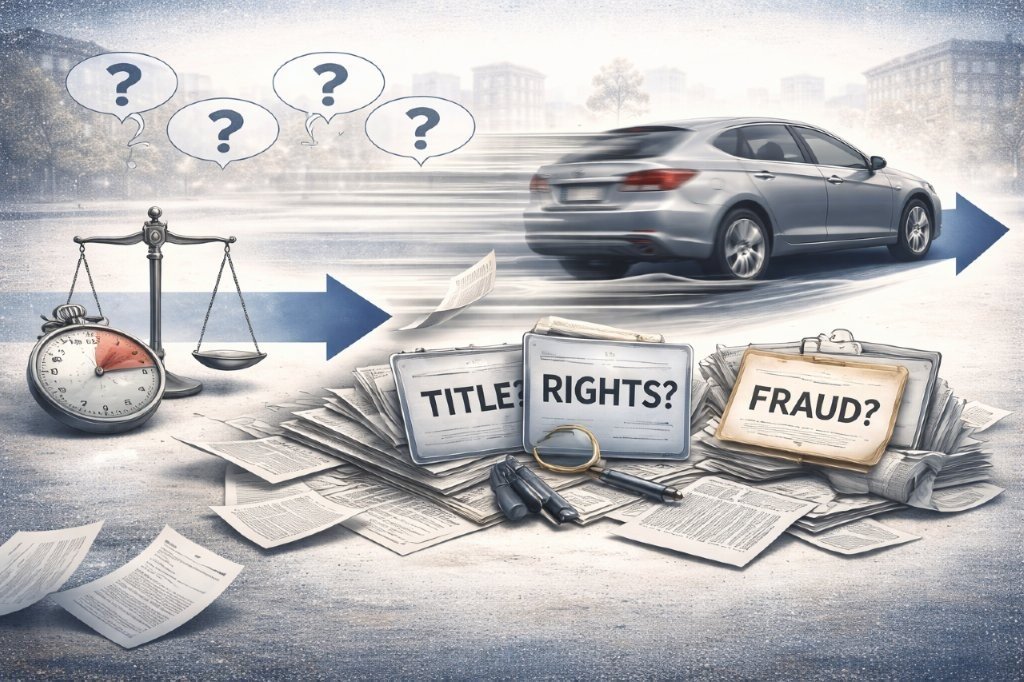
In many recovered vehicle cases, the central issue is not whether police were entitled to seize the vehicle, but what happens afterwards. Once a vehicle has been taken into police possession, decisions must be made about its future. If those decisions are made too quickly, without allowing time for competing claims to be examined, one party may gain a significant advantage while another is left struggling to challenge the outcome.
This article examines a procedural concern that can arise after a vehicle is seized: premature disposal or transfer of the vehicle to another party.
In cases involving innocent purchasers, timing can be critical.
The buyer may need time to gather documentation, contact the seller, communicate with insurers or seek legal advice.
If the vehicle is handed over immediately to another claimant, the practical balance of the dispute can change dramatically.
The purpose of this article is not to criticise police seizure itself, but to explore whether greater caution should sometimes be exercised before deciding the vehicle’s ultimate destination.
When a vehicle suspected of being stolen is seized, the immediate priority is usually investigative – of the vehicle, not its movements.
Officers must confirm the vehicle’s identity. There may be little or no time to examine records. Will consideration be given to determining whether the theft report is accurate; an ‘investigation’ of the original theft offence actually occur?
In the absence of such steps, how is an informed decision made about who should receive the vehicle?
In straightforward cases the answer may be obvious. If the vehicle is recovered directly from the person who stole it, returning it to the original owner may involve little controversy!
However, the situation becomes more complex when the vehicle is found in the hands of a buyer who purchased it legitimately. At that point there may be competing claims:
- the person who reported the vehicle stolen
- an insurer asserting title after settling a claim
- the innocent purchaser currently in possession
Each party may have evidence supporting their position.
If police transfer the vehicle immediately to one claimant, that decision can significantly affect the balance of the dispute. Even if the legal position remains open to challenge, the person without the vehicle may now face greater difficulty pursuing their claim.
They may need to start legal proceedings simply to restore the situation to what it was before the transfer. They necessarily need information, facts that are not always forthcoming.
Allowing a short period for parties to gather information or communicate with one another could sometimes reduce the likelihood of unnecessary disputes and complaints.
Should police allow time for competing claims to be examined before transferring a recovered vehicle to another party?
Next post – 6
A 13-Part Investigative Series on Theft, Recovery, Innocent Purchasers and Ownership Disputes – an overview and the individual posts:
- 11/03/2026 – A Crime Report Is Not a Title Decision
- 13/03/2026 – The Innocent Purchaser: The Forgotten Victim in Vehicle Recovery
- 22/03/2026 – Who helps the innocent? Should the Original Police Force Normally Handle the Innocent Purchaser’s Crime?
- 24/03/2026 – Police Powers to Seize Are Not Powers to Decide Ownership
- 26/03/2026 – Do Police Hand Vehicles Over Too Quickly?
- 01/04/2026 – The Police (Property) Act: A Route Many People Never Hear About
- 07/04/2026 – Insurers Often Examine More Than the Police
- 09/04/2026 – Theft to Recovery: The Longer the Gap, the Harder the Truth
- 14/04/2026 – Trackers Do More Than Recover Cars
- 21/04/2026 – The Badge, the Buyer and the Power Imbalance
- 23/04/2026 – Good Faith Is Not Enough
- 26/04/2026 – The Inexpensive Check That May Save Thousands
- 30/04/2026 – What Better Practice Would Look Like
The
Website Disclaimer
The information provided on this website is for general informational and research purposes only. While we strive to ensure that all content is accurate, up to date, and relevant, laws and regulations are constantly evolving. As such, the information presented may not reflect the most current legal standards or interpretations.
Nothing on this website should be construed as legal advice or a substitute for professional legal counsel. If you require legal assistance or advice specific to your circumstances, you should consult a qualified lawyer.
We accept no responsibility or liability for any errors, omissions, or inaccuracies in the content, nor for any reliance placed upon the information provided. The use of this website and its content is entirely at your own risk.
By continuing to use this website, you acknowledge and agree to these terms.