11. Good Faith Is Not Enough
Innocence, Title and the Limits of Fairness
Many people assume that buying a vehicle honestly should guarantee their right to keep it.
If the buyer paid market value and had no knowledge that the vehicle was stolen, fairness would seem to demand that they retain ownership. Unfortunately, the law does not always follow this intuition. In many circumstances, a person who unknowingly purchases a stolen vehicle may still lose it to the original owner or another party with a stronger legal claim.
From a common-sense perspective, the innocent purchaser appears blameless. They entered into the transaction in good faith and believed the sale to be legitimate. However, property law operates according to different principles.
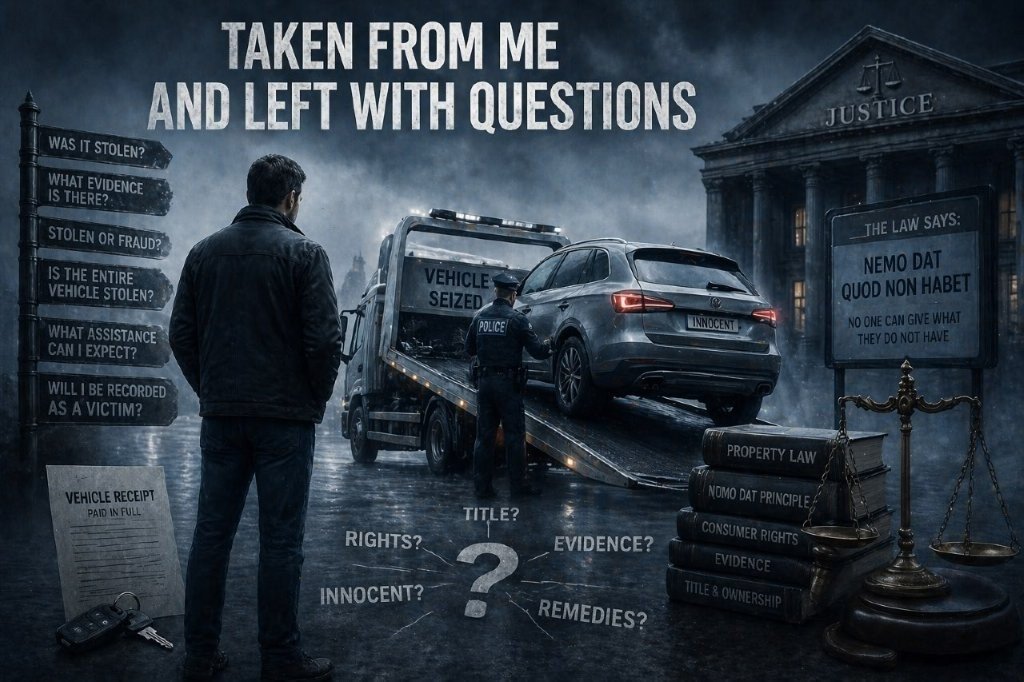
The general rule is that a person cannot transfer better title than they themselves possess; the ‘Nemo Dat‘ principle.
If a seller did not have the right to sell the vehicle, the buyer may not acquire full legal ownership.
Understanding this distinction helps explain why disputes involving innocent purchasers can be so difficult to resolve.
The principle underlying many property disputes is often summarised by the Latin phrase nemo dat quod non habet, meaning “no one can give what they do not have.” In simple terms, this means that a seller cannot transfer ownership rights that they themselves do not possess.
A thief acquires ‘possession‘ of a vehicle they steal, not ‘ownership’ (title). If they later sell the vehicle, they pass what they have – possession. They do not have and cannot pass ‘title’.
Therefore, if the vehicle is sold by someone without the authority to sell it, the buyer may not obtain full legal title — even if the buyer acted honestly and had no knowledge of the theft. This result can appear harsh.
The buyer may feel they have done everything reasonably expected of them. They may have paid market value, completed paperwork and insured the vehicle. Yet the law’s primary concern is determining who holds the stronger legal claim to the property.
This does not mean the innocent purchaser has no remedies.
They may be able to pursue legal action against the seller who sold the vehicle. They may also have rights under consumer protection legislation if the vehicle was purchased from a trader. Then there are more complex issues:
- was the vehicle actually stolen?
- what evidence is there is was stolen?
- was it taken by fraud, not stolen?*
- is the entire vehicle stolen?
*title considerations differ.
- what assistance can an innocent purchaser expect from the police?
- will they be recorded as a victim of crime
Nevertheless, the distinction between innocence and title is one reason why recovered vehicle cases can become legally complex. The challenge for the system is to ensure that the process for resolving these disputes remains fair, transparent and understandable.
Should the law do more to protect innocent purchasers who unknowingly buy stolen vehicles?
Linked – ‘Establishing Innocence‘ anecdotes
A 13-Part Investigative Series on Theft, Recovery, Innocent Purchasers and Ownership Disputes – an overview and the individual posts:
- 11/03/2026 – A Crime Report Is Not a Title Decision
- 13/03/2026 – The Innocent Purchaser: The Forgotten Victim in Vehicle Recovery
- 22/03/2026 – Who helps the innocent? Should the Original Police Force Normally Handle the Innocent Purchaser’s Crime?
- 24/03/2026 – Police Powers to Seize Are Not Powers to Decide Ownership
- 26/03/2026 – Do Police Hand Vehicles Over Too Quickly?
- 01/04/2026 – The Police (Property) Act: A Route Many People Never Hear About
- 07/04/2026 – Insurers Often Examine More Than the Police
- 09/04/2026 – Theft to Recovery: The Longer the Gap, the Harder the Truth
- 14/04/2026 – Trackers Do More Than Recover Cars
- 21/04/2026 – The Badge, the Buyer and the Power Imbalance
- 23/04/2026 – Good Faith Is Not Enough
- 26/04/2026 – The Inexpensive Check That May Save Thousands
- 30/04/2026 – What Better Practice Would Look Like
Website Disclaimer
The information provided on this website is for general informational and research purposes only. While we strive to ensure that all content is accurate, up to date, and relevant, laws and regulations are constantly evolving. As such, the information presented may not reflect the most current legal standards or interpretations.
Nothing on this website should be construed as legal advice or a substitute for professional legal counsel. If you require legal assistance or advice specific to your circumstances, you should consult a qualified lawyer.
We accept no responsibility or liability for any errors, omissions, or inaccuracies in the content, nor for any reliance placed upon the information provided. The use of this website and its content is entirely at your own risk.
By continuing to use this website, you acknowledge and agree to these terms.