
25/02/2026 – to the ICO – Case Reference IC-356699-W0G6
Further to the ongoing matter concerning SAR handling and section 184 DPA considerations, I write to provide contextual material which may assist your understanding of procedural issues arising in practice.
I have recently published an anonymised précis outlining a disclosure scenario involving administrative delay where personal data clearly existed but was not released pending internal filing status (copy attached). The article does not allege misconduct but highlights a procedural distinction between statutory SAR obligations and internal workflow. For completeness, the piece (within the attached) can be found here.
I provide this simply as contextual illustration of the practical issues that can arise where disclosure processes appear to depend on administrative milestones rather than the existence of recorded personal data. I am conscious that consistency in SAR interpretation across forces is important to public confidence, which is why I thought it appropriate to share this related example.
I appreciate the ICO’s consideration of the wider consistency implications in the Essex matter.
Thames Valley Police (TVP) ‘4-Options’
16/01/2024 – After having raised the spectre of the TP SAR approach amounting to a section 184 DPA criminal offence (and having apologised for doing so), TVP issued their ‘4 Options’ approach to the disclsoure of police reports:
- Subject Access Request (SAR)
- Consent
- Court Order
- Interview of Attending Officer
The disclosure can be read in the public domain at WhatDoTheyKnow.com. A local copy can be read here.
When agreed disclosure procedures exist — but are not followed
February 24, 2026 – LinkedIn Article
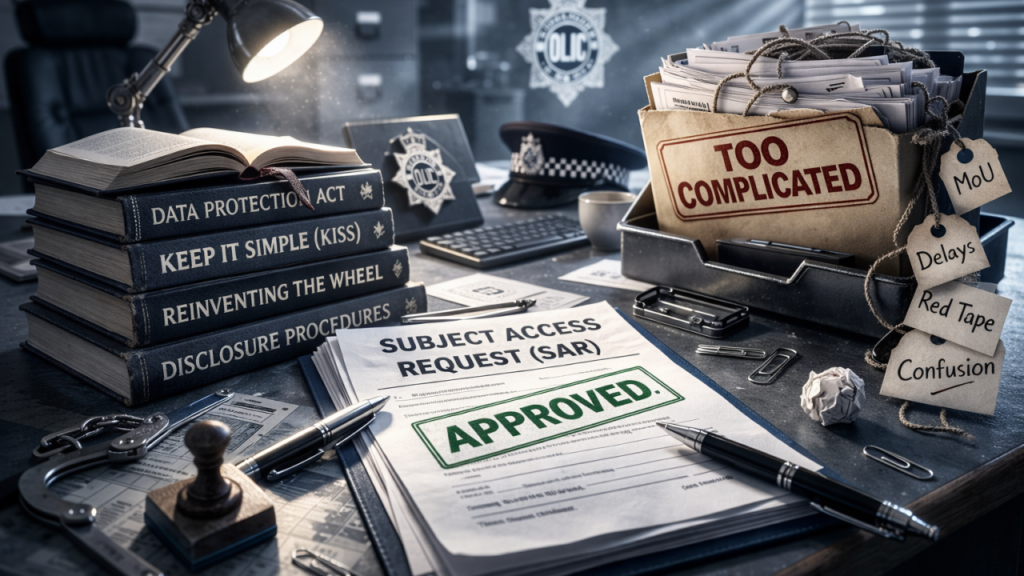
A recurring issue in vehicle theft cases is not recovery — but what happens afterwards.
In a recent case, a victim made a Subject Access Request (SAR) to obtain their own crime report. This followed established procedures previously confirmed by the police force concerned in a formal Freedom of Information response.
However, disclosure was refused on the basis that the report had not yet been “filed,” despite:
- the vehicle having been recovered
- forensic examination having been completed
- no suspect having been identified
- personal data clearly existing within police systems
The explanation given was not investigative necessity, but administrative status and supervisory availability.
This raises an important question:
If disclosure rights depend not on law, but on internal workflow, are statutory rights truly meaningful?
SAR rights exist precisely to provide transparency and allow individuals to understand what information is held about them.
When forces publish procedures explaining how disclosure can be obtained, the public is entitled to expect those procedures will be followed in practice. The relevant FOI response. the disclosure options, can be read here: ‘SAR & Consent‘.
The anonymised chronology can be found here.
Transparency is not achieved by publishing policies alone — but by applying them consistently.
Ultimately, this is not about technicalities. It is about ensuring that when victims follow the published procedure, the procedure works.
Where a constabulary has already explained publicly that SAR is an appropriate route for disclosure, applying that procedure consistently benefits everyone:
- Victims receive clarity.
- Investigations remain protected through redaction where necessary.
- Administrative burden is reduced.
- Public confidence is strengthened.
The Data Protection Act requires disclosure within one calendar month. The procedure is clear, lawful, and proportionate. No additional or convoluted arrangements are required where the statutory route already exists.
Transparency, applied consistently, supports both victims and policing.
And finally, for those assisting victims:
When submitting a SAR, be precise. Specify the crime report and associated incident data.
- You are not asking for medical records.
- You are not asking for criminal records
Just the report.
Sometimes clarity avoids complexity.
LinkedIn article comments
Mark Whinton:
Public perception of the Police is degraded in such cases for two main
reasons. 1. Police agencies must always be seen as upholding the rule of law and never
ignoring it. 2. If connected to auto theft investigations it further supports public criticism of
a lack of concern.
Philip Swift
In the UK, there does appear to be a disconnect at times within the system.
Frontline officers dealing with theft reports often show empathy and genuinely want to
help victims through what can be a distressing experience.
However, once matters move into administrative or disclosure processes, the experience
can feel markedly different — more procedural and less attuned to the victim’s
circumstances.
For someone whose vehicle has been stolen and not recovered in an “as was” condition,
timely information can be critical — particularly where an insurer is awaiting
confirmation before progressing a claim.
Improving alignment between operational response and administrative process would
likely enhance public confidence and reduce secondary distress for victims.
Gary Moore
Detective Sergeant (Acquisitive Crime)
I see this daily. All the work has been done and crime reports looking bare.
Philip Swift
Many crime reports understandably capture the core facts required for recording
purposes, particularly given workload and time pressures. However, from a victim and
insurer perspective, the narrative sections can sometimes feel limited in terms of
investigative context or clarity.
That is not necessarily a reflection of individual officers, but rather of recording
frameworks, resource constraints, and competing priorities.
The wider issue often arises at the point of disclosure. Where administrative processes
operate separately from the operational reality — or where available mechanisms are
applied conservatively — the result can be delay for victims awaiting clarity and insurers
awaiting confirmation.
The distinction matters. Public frustration is frequently directed at frontline policing, yet
many of the secondary difficulties experienced by victims arise within process and
governance structures rather than operational response. Better alignment between
recording, review, and disclosure would likely reduce that friction and support earlier
resolution
Agreed Police disclosure procedures not followed
A recurring issue in vehicle theft cases is not recovery, but what happens afterwards.
In a recent case, a stolen vehicle was recovered, albeit damaged and released by police on 5th January 2026, indicating that enquiries at the scene and forensic examination had been completed sufficiently to allow its return. A second vehicle stolen at the same time remained outstanding.
The victim submitted a Subject Access Request (SAR) in mid-January to obtain a copy of their own crime report. This followed established procedures previously confirmed by the constabulary concerned in a formal Freedom of Information response.
However, on the 16th January, disclosure of the crime report was refused on the basis that it had not yet been “filed,” despite the fact that:
- the vehicle had been recovered;
- forensic examination had been completed; and
- the vehicle had been released for collection in early January 2026.
The forensic examination report was received on or about 9th February, and confirmed that no suspect had been identified.
On the 12th February 2026, the detective explained that the report required supervisory review before it could be filed, and that this could not occur until his supervising sergeant returned from leave … at the end of February
This raises important questions about process and timing.
Personal data clearly existed within police systems. The issue was not the absence of information, but its administrative status. Where disclosure was delayed, the explanation given was not investigative sensitivity, but internal workflow and supervisory availability. This distinction matters.
Why this matters
Subject Access rights exist to allow individuals to understand what personal data is held about them. These rights apply to recorded personal data, regardless of whether internal administrative processes, such as supervisory review or formal filing, have been completed.
When constabularies publish procedures explaining how disclosure can be obtained, the public is entitled to expect those procedures will operate consistently in practice. The relevant Freedom of Information response explaining these procedures can be read here.
Transparency depends not only on policy, but on implementation.
The forensic report and disclosure
It is also important to recognise that, at the time the Subject Access Request was submitted and subsequently refused, the forensic examination report had not yet been received by the investigating officer.
In those circumstances, disclosure of the crime report would simply have reflected the factual position at that time, namely, that forensic enquiries were ongoing and results were pending.
The subsequent receipt of the forensic report on 9 February 2026, confirming that no suspect had been identified, did not alter the existence of the underlying crime record or the personal data already held within police systems.
This suggests that the timing of forensic examination was not, in itself, determinative of whether disclosure could occur, but rather formed part of the broader investigative timeline.
It highlights the importance of ensuring that administrative processes operate in a manner that reflects the purpose of disclosure rights, namely, to provide access to personal data held, rather than being dependent solely upon internal procedural milestones.
It is important to emphasise that this concern relates to the process rather than the individuals. The victim has complied fully with established procedures and is entitled to expect that disclosure decisions are made consistently and in accordance with statutory obligations. Raising these questions is intended to ensure clarity and consistency, and to assist in improving understanding of how disclosure processes operate in practice.
The irony of recovery
This case also illustrates an unexpected consequence.
Had the vehicle not been recovered, the investigation might have reached an earlier administrative conclusion, allowing disclosure to proceed sooner. Instead, recovery introduced additional procedural steps.
The vehicle was recovered and released on 5 January 2026.
Forensic results were available to the investigating officer by 9 February 2026. Yet disclosure remained unavailable weeks later, pending supervisory review, and has yet to occur!
Recovery, normally a positive outcome, therefore had the unintended effect of delaying access to information needed by the victim.