3. Who Helps The Innocent?
Should the Original Police Force Normally Handle the Innocent Purchaser’s Crime?
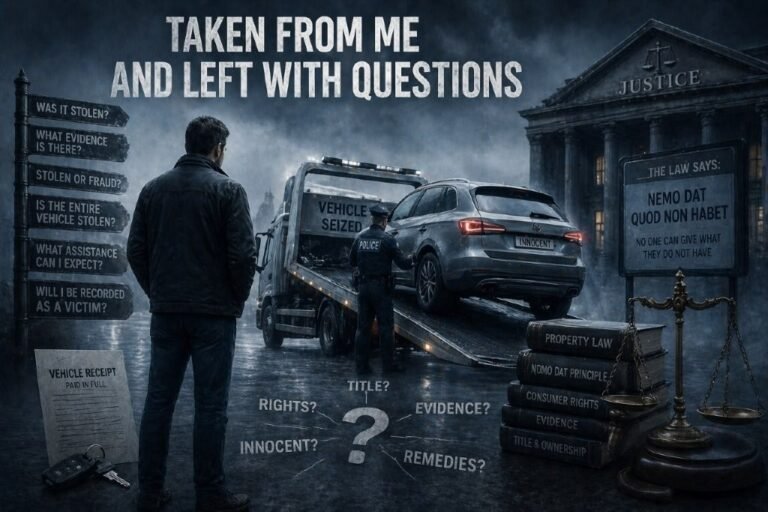
When a stolen vehicle is recovered from an innocent purchaser, responsibility for dealing with that purchaser’s position is often unclear. In some cases the buyer is directed to report fraud elsewhere or pursue civil remedies independently. Yet the innocent purchaser’s situation arises directly from the same chain of events that began with the original theft report.
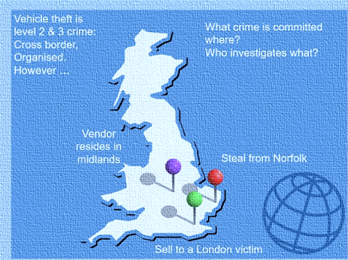
For that reason, the police force that recorded the theft is arguably often the authority best placed to investigate the full timeline and address the issues that arise when the vehicle is later recovered. It is, after all, the initial constabulary’s crime but … it will likely be argued (assuming the subject is raised) that the innocent purchaser was duped, defrauded, elsewhere, within the jurisdiction of another police service. Furthermore, the purchaser was subject to FRAUD … a complicated, resource-heavy offence; they can be directed to ActionFraud, now ‘Report Fraud‘.
This article examines a practical problem within vehicle recovery cases:
- who should investigate the innocent purchaser’s position once a stolen vehicle is identified?
Currently, the response can be inconsistent. The purchaser may be referred elsewhere or encouraged to pursue civil action against the seller – assuming they can be identified; an aspect that should likely interest law enforcement staff not simply to assist the purchaser.
While these options may exist, they often detach the purchaser’s problem from the original theft investigation.
The purpose of this article is to argue that, in many cases, the police force that recorded the theft is best placed to examine the entire chain of events — from the reported theft to the eventual recovery of the vehicle. This approach would promote continuity, improve investigative efficiency and ensure that the innocent purchaser’s evidence contributes to understanding what happened to the vehicle after it was taken.
The starting point is the theft report itself.
When a vehicle is reported stolen, the police service receiving the report creates the crime record and becomes responsible for investigating the offence. That constabulary holds the initial account of the theft and the earliest available evidence relating to the vehicle’s disappearance.
If the vehicle later appears hundreds of miles away in the possession of a buyer, the situation becomes part of the same investigative timeline.
From an investigative perspective, the innocent purchaser may provide valuable information about what happened to the vehicle after it was taken. They may know:
- who sold them the vehicle
- where the sale occurred
- how the vehicle was advertised
- what documents were provided
- what communications took place before the purchase
- the payment method
This information could potentially assist in identifying individuals involved in handling or reselling stolen vehicles.
However, if the purchaser is simply redirected into a separate fraud reporting system, that evidence may become disconnected from the original theft investigation. The result is fragmentation.
Instead of a single coherent timeline from theft to recovery, the evidence becomes scattered across multiple reporting routes and jurisdictions.
Assigning responsibility to the original police force would create a clearer investigative structure. That force already holds the theft report and is therefore best positioned to connect the purchaser’s account to the broader investigation. It would also reduce unnecessary administrative duplication and help avoid situations in which innocent purchasers feel they have been passed from one authority to another without meaningful assistance.
The above assumes the police will investigate and assist, that the approach is not simply ‘theft is a negative, recovery is a positive, the balance is restored’
Where does this leave the party or parties between these events?
Question: Should the constabulary that records a vehicle theft normally be responsible for investigating what happens when the vehicle is later found in the hands of an innocent purchaser?
05/2026 hearsay comment: and development is a further result of reduced resources, increased responsibilities:
- Where a vehicle is stolen and reported to constabulary A then
- Located within the jurisdiction of constabulary B
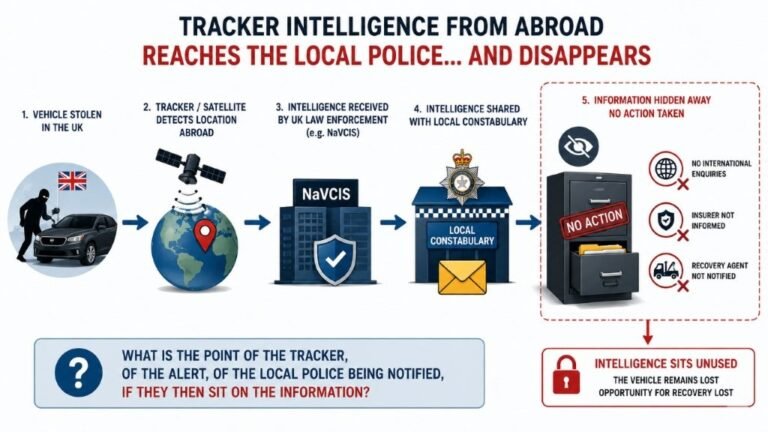
- constabulary B are apparently deprioritising the matter as the recovery does not reflect positively on their detection (or recovery) rates
A 13-Part Investigative Series on Theft, Recovery, Innocent Purchasers and Ownership Disputes – an overview and the individual posts:
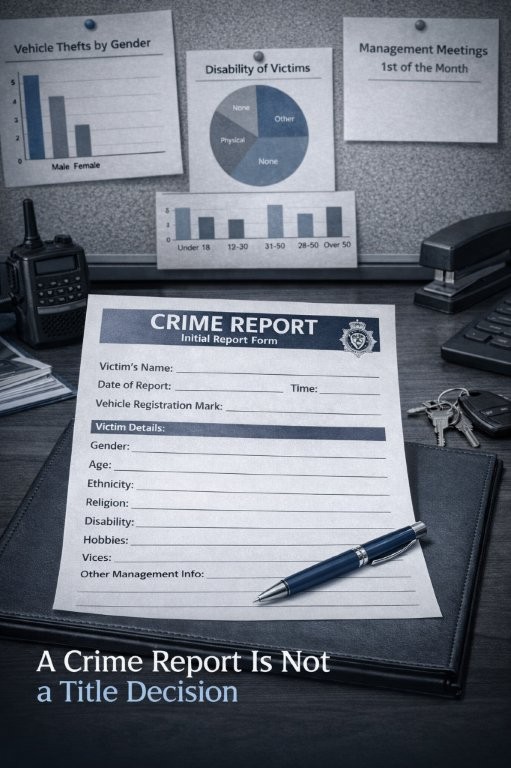
- 11/03/2026 – A Crime Report Is Not a Title Decision
- 13/03/2026 – The Innocent Purchaser: The Forgotten Victim in Vehicle Recovery
- 22/03/2026 – Who helps the innocent? Should the Original Police Force Normally Handle the Innocent Purchaser’s Crime?
- 24/03/2026 – Police Powers to Seize Are Not Powers to Decide Ownership
- 26/03/2026 – Do Police Hand Vehicles Over Too Quickly?
- 01/04/2026 – The Police (Property) Act: A Route Many People Never Hear About
- 07/04/2026 – Insurers Often Examine More Than the Police
- 09/04/2026 – Theft to Recovery: The Longer the Gap, the Harder the Truth
- 14/04/2026 – Trackers Do More Than Recover Cars
- 21/04/2026 – The Badge, the Buyer and the Power Imbalance
- 23/04/2026 – Good Faith Is Not Enough
- 26/04/2026 – The Inexpensive Check That May Save Thousands
- 30/04/2026 – What Better Practice Would Look Like
Website Disclaimer
The information provided on this website is for general informational and research purposes only. While we strive to ensure that all content is accurate, up to date, and relevant, laws and regulations are constantly evolving. As such, the information presented may not reflect the most current legal standards or interpretations.
Nothing on this website should be construed as legal advice or a substitute for professional legal counsel. If you require legal assistance or advice specific to your circumstances, you should consult a qualified lawyer.
We accept no responsibility or liability for any errors, omissions, or inaccuracies in the content, nor for any reliance placed upon the information provided. The use of this website and its content is entirely at your own risk.