Skip to content
Car Crime U.K.

Car Crime U.K.

Understanding Vehicle Theft, Fraud and Identity

Menu
  • Vehicle Crime
    • ‘Form A Squad’ – Ineffective Action
      • The Vehicle Crime Task Force (VCT) – 2019
      • 2022 to 2023 National Vehicle Crime Working Group
    • Stolen Vehicle Recovery – Found in the U.K.
    • Stolen Vehicle Recovery – Found Abroad
    • OPERATION IGNEOUS – reducing reported car theft by 30%
    • Title Law
  • LoS* Data
  • Guidance / Help
    • Abbreviations & Terminology
    • Resources
      • Your Vehicle Theft Insurance Claim
      • Police Contact Emails
    • Links
  • Police Reports
    • Police Theft Reports
    • Police Collision Reports
    • Police Disclosure Delays
  • News
  • Policy & Research
  • Articles Archive
  • Contact
Menu

4. Police Powers to Seize Do Not Decide Ownership

Posted on March 20, 2026March 20, 2026 by 5@mwosb.co.uk

When police officers seize a vehicle suspected of being stolen, most people assume the matter is legally settled. The vehicle is taken, and the person who reported it stolen will eventually receive it back. However, this assumption overlooks an important distinction within the law.

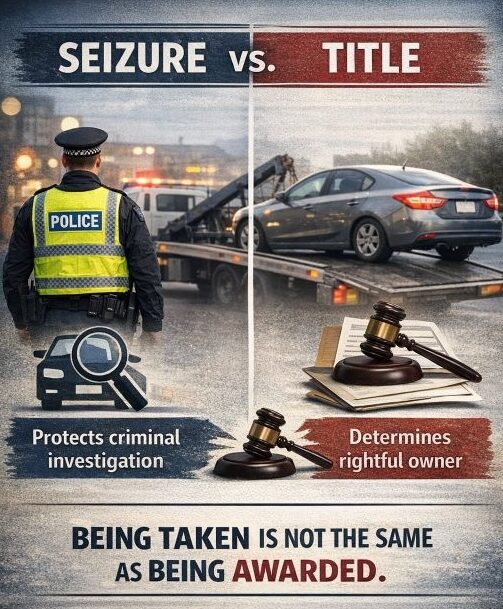
Police powers to seize property exist for investigative and evidential purposes, but those powers do not automatically determine who ultimately owns the property or who should receive it.


This article addresses a widespread misunderstanding surrounding vehicle recovery: the belief that police seizure automatically resolves questions of ownership.

In reality, the legal authority to seize property and the legal determination of ownership are separate issues.

Police officers may lawfully take possession of property suspected to be stolen in order to preserve evidence or prevent further offences. However, deciding between competing claims to property – particularly where an innocent purchaser is involved – can require a different process altogether.
The purpose of this article is to explain this distinction and why it matters for individuals who suddenly find themselves caught in a vehicle recovery dispute.


Police powers to seize property exist primarily to support criminal investigations – which it appears generally means ‘to establish the (true) identity‘

If officers reasonably believe a vehicle may be stolen, they may take possession of it in order to investigate the suspected offence. In many cases this is entirely appropriate and necessary.

However, the act of seizure does not resolve every question that may arise afterwards. In particular, seizure does not necessarily determine who ultimately has the better claim to possession or ownership of the vehicle. This is where confusion can arise.

Members of the public tend to assume that police decisions about seized property carry the same authority as a court ruling. When an officer states that a vehicle is stolen and must be returned, the natural reaction is to accept that statement as final. The reality can be more nuanced.

Ownership disputes often involve questions of civil law. These questions may require careful consideration of purchase history, documentation, contractual relationships and competing claims.
In situations where a vehicle has passed through several hands, determining the correct outcome may not be straightforward. This does not mean police seizure is wrong or inappropriate.

  • It simply means that seizure and ownership are not identical concepts.

Recognising that distinction is important because it ensures that individuals understand their position and the processes available to challenge or clarify competing claims.


Do you believe most people understand that police seizure of property does not automatically decide who owns it?

Next post – 5

The Series:

  1. 09/03/2026 – A Crime Report Is Not a Title Decision
  2. 13/03/2025 – The Innocent Purchaser: The Forgotten Victim in Vehicle Recovery
  3. 17/03/2026 – Who helps the Innocent? Should the Original Police Force Normally Handle the Innocent Purchaser’s Crime?
  4. 20/03/2026 – Police Powers to Seize Are Not Powers to Decide Ownership
  5. Do Police Hand Vehicles Over Too Quickly?
  6. The Police (Property) Act: A Route Many People Never Hear About
  7. Insurers Often Examine More Than the Police
  8. Theft to Recovery: The Longer the Gap, the Harder the Truth
  9. Trackers Do More Than Recover Cars
  10. The Badge, the Buyer and the Power Imbalance
  11. Good Faith Is Not Enough
  12. The Inexpensive Check That May Save Thousands
  13. What Better Practice Would Look Like

Reference & Relevant

  • The Devalued Crime Report
  • Crime Number Devaluation
  • Crime Recorded ≠ Crime Verified
  • Crime Reports – Duplication
  • ‘taking him at his word, they (the police) issued a crime reference number‘
  • When Recorded Theft Is Not Believed
  • L.I.E. – When Taking is not Theft: The Hidden Cost of Misreported Vehicle Crimes – Car Crime U.K.
  • Vehicle Theft Surge Demands Police Action on Crime Report Disclosures

Legislation – potentially relevant

  • Sale of Goods Act 1979, section 21: the basic nemo dat rule – a seller who is not the owner generally cannot pass better title than he has.
  • Consumer Rights Act 2015, section 17: where goods are supplied by a trader, the contract includes a term that the trader has the right to sell or transfer them; useful for the innocent purchaser’s civil remedies against the seller.
  • Torts (Interference with Goods) Act 1977: relevant to conversion and civil disputes over wrongful interference with goods; legislation commentary expressly uses the example of a good-faith buyer of a stolen car being sued by the true owner.
  • Police (Property) Act 1897, section 1: magistrates’ court power to order delivery of property in police possession to the person appearing to be the owner, or otherwise make such order as seems fit.
  • Criminal Procedure Rules 2025, rule 47.37: procedural mechanism for applications under the Police (Property) Act.
  • Police and Criminal Evidence Act 1984, section 19, and Theft Act 1968, section 26: police powers relevant to seizure/search of suspected stolen goods.
  • Human Rights Act 1998, Article 1 of Protocol 1: protects possessions and supports proportionality/procedure arguments where property is withheld or transferred.

Further case law and information can be found here


Website Disclaimer

The information provided on this website is for general informational and research purposes only. While we strive to ensure that all content is accurate, up to date, and relevant, laws and regulations are constantly evolving. As such, the information presented may not reflect the most current legal standards or interpretations.

Nothing on this website should be construed as legal advice or a substitute for professional legal counsel. If you require legal assistance or advice specific to your circumstances, you should consult a qualified lawyer.

We accept no responsibility or liability for any errors, omissions, or inaccuracies in the content, nor for any reliance placed upon the information provided. The use of this website and its content is entirely at your own risk.

By continuing to use this website, you acknowledge and agree to these terms.


Leave a Reply Cancel reply

Your email address will not be published. Required fields are marked *

Recent Posts:

  • 4. Police Powers to Seize Do Not Decide Ownership
  • 3. Who Helps The Innocent?
  • Remote Technology and Stolen Vehicles
  • 2. The Innocent Purchaser
  • The ICO – running out of time?
  • 1. A Police Crime Report Is Not a Title Decision
  • The Problem With Crime Numbers:
  • When Recorded Theft Is Not Believed
  • NaVCIS Funding: Still No Specifics
  • Agreed Police disclosure procedures not followed
  • £50 for a Police Report Update?
  • Section 184 Data Protection Act 2018
  • Keyless Taking or Key Questions?
  • When ‘Sale or Return’ Goes Wrong
  • BBC Crimewatch ‘Car Cloning’
  • Keyless Vehicle Theft:
  • Accusations of Criminality
  • Thefts Down – Except for Newer Cars!
  • Increase Pre-Crush Retention Period to 28 days?
  • Reducing Vehicle Theft by up to 30%
  • ‘The Others’ … are you among them?
  • Vehicle Abandonments Raise Questions Over Theft Claims
  • The State of Vehicle Taking in the UK: A Crisis of Enforcement, Not Engineering
  • Keystone Krooks – but £1.4 million stolen!
  • 2024 Vehicle Theft – how well (or otherwise) did your constabulary perform?
  • Vehicle Crime. Is Police Language Bluring Facts?
  • Superficial Approach to Vehicle Taking Overlooked Organised Crime
  • Keyless Vehicle Taking – Really?
  • Accuracy & Consistency Required
  • Do we need new legislation?
  • A System Built on Blind Faith? The Flaws in Police Information Dissemination
  • Which? … What?
  • The Rise & Fall of Operation Igneous
  • Vehicle Taking – Quantity not Quality
  • Vehicle Theft: 30 years of Complacency
  • The Devalued Crime Report
  • Vehicle Theft Surge Demands Police Action on Crime Report Disclosures
  • FoIA – Staffordshire Police are not the worst offenders
  • Vehicle Repatriation
  • Crime Number Devaluation
  • Manufacturers Cause Vehicle Thefts …
  • PNC LoS Report Weeding
  • Staff-less-shire Police Report Disclosures
  • W. Mercia Police – RTC Report Disclosures
  • Delaying Finalisation of Insurance Claims (for some)
  • Policing (or not?) Vehicle Theft
  • Fraud Not Theft … face the facts!
  • Cloned Plates: Register of Keepers – Lacking Integrity?
  • Police Theft Report Disclosure
  • Headlamp Dazzle & Eye-Snatching
  • Scrap ‘six-week weeding’ of stolen vehicle VRMs
  • Police Vehicle Theft Reports – A Lack Of Understanding And Standardisation

Legal Disclaimer
The information provided on this website is for general informational purposes only and should not be considered legal advice. While we strive to ensure the accuracy and relevance of the content, laws and regulations change frequently, and the application of legal principles varies based on specific circumstances.

No Legal Advice
Nothing on this website constitutes legal, financial, or professional advice. You should not rely on the information provided here as a substitute for seeking qualified legal counsel. If you require legal advice or guidance, we strongly recommend consulting a licensed solicitor or legal professional.

No Liability
We make every effort to keep the information up to date and accurate, but we do not guarantee the completeness, correctness, or applicability of any content. We accept no responsibility or liability for any errors, omissions, or reliance placed on the information contained within this site.

External Links & Third-Party Content
Any external links or references provided are for convenience only and do not constitute endorsement. We are not responsible for the accuracy, legality, or content of any external sites or third-party materials linked from this website.

User Responsibility
It is the responsibility of all users to verify the accuracy and relevance of any information before relying upon it. If you have a legal issue, you should seek advice from a qualified professional relevant to your situation.

By using this website, you acknowledge and agree to this disclaimer. If you do not agree, you should discontinue use of the site immediately.

© 2026 Car Crime U.K. | Powered by Superbs Personal Blog theme