9. Trackers Do More Than Recover Cars
Trackers Preserve Evidence
Vehicle trackers are often discussed purely as a theft-recovery tool. Their primary purpose is seen as helping police, or specialist companies, locate stolen vehicles quickly.
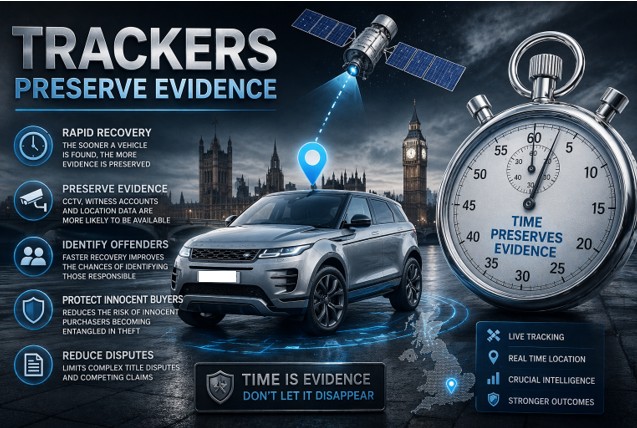
Yet trackers can play a much broader role than simply finding a car. Rapid recovery can preserve evidence, protect innocent buyers from later disputes, and significantly improve the chances of identifying those responsible for vehicle theft and resale.
Trackers do not necessarily prevent theft. Whilst a potential deterrent, criminals may still target vehicles equipped with tracking devices. However, trackers can dramatically shorten the time between the theft and the recovery of the vehicle.
As discussed in the previous article, time plays a crucial role in determining whether a recovered vehicle case remains straightforward or becomes a complex dispute involving insurers, buyers and competing claims to ownership. By acting faster and enabling recovery, trackers can help preserve the evidential trail that would otherwise fade with time.
When a vehicle is stolen, the most valuable resource for investigators is time. The sooner a vehicle can be located, the greater the chance of identifying:
- where the vehicle was taken
- how it was moved
- who handled it
- where it was stored or prepared for resale
Rapid recovery often means that evidence such as CCTV footage, witness accounts and location data are still available.
If the vehicle is recovered quickly, there is also a much lower chance that it will be sold on to another buyer. This reduces the likelihood of innocent purchasers becoming entangled in the aftermath of the theft.
In contrast, vehicles that remain missing for extended periods are more likely to pass through multiple hands before being discovered. By that stage, reconstructing the vehicle’s movements can become extremely difficult.
From a policing perspective, trackers therefore serve a dual purpose.
- They increase the chances of recovering the vehicle itself, but
- they also improve the chances of identifying the individuals involved in the theft and subsequent handling of the vehicle.
For vehicle owners, the benefits extend beyond recovery. Faster recovery limits financial losses, inconvenience and stress, It also helps prevent situations in which innocent purchasers unknowingly buy stolen vehicles; reduces the risk of complex title disputes,
Why not fit a tracker to a vehicle if it significantly increased the chance of recovering it quickly after theft?
More about:
Next post – 10 The Badge, the Buyer and the Power Imbalance
A 13-Part Investigative Series on Theft, Recovery, Innocent Purchasers and Ownership Disputes – an overview and the individual posts:
- 11/03/2026 – A Crime Report Is Not a Title Decision
- 13/03/2026 – The Innocent Purchaser: The Forgotten Victim in Vehicle Recovery
- 22/03/2026 – Who helps the innocent? Should the Original Police Force Normally Handle the Innocent Purchaser’s Crime?
- 24/03/2026 – Police Powers to Seize Are Not Powers to Decide Ownership
- 26/03/2026 – Do Police Hand Vehicles Over Too Quickly?
- 01/04/2026 – The Police (Property) Act: A Route Many People Never Hear About
- 07/04/2026 – Insurers Often Examine More Than the Police
- 09/04/2026 – Theft to Recovery: The Longer the Gap, the Harder the Truth
- 14/04/2026 – Trackers Do More Than Recover Cars
- 21/04/2026 – The Badge, the Buyer and the Power Imbalance
- 23/04/2026 – Good Faith Is Not Enough
- 26/04/2026 – The Inexpensive Check That May Save Thousands
- 30/04/2026 – What Better Practice Would Look Like
Website Disclaimer
The information provided on this website is for general informational and research purposes only. While we strive to ensure that all content is accurate, up to date, and relevant, laws and regulations are constantly evolving. As such, the information presented may not reflect the most current legal standards or interpretations.
Nothing on this website should be construed as legal advice or a substitute for professional legal counsel. If you require legal assistance or advice specific to your circumstances, you should consult a qualified lawyer.
We accept no responsibility or liability for any errors, omissions, or inaccuracies in the content, nor for any reliance placed upon the information provided. The use of this website and its content is entirely at your own risk.
By continuing to use this website, you acknowledge and agree to these terms.