When ‘Many Requests’ may not mean ‘Many Requests’

A troubling pattern emerging in some police section 14 FOIA refusals?

Freedom of Information Act section 14(1) allows a public authority to refuse a request where it considers the request to be “vexatious”.

In principle, that is understandable. Authorities should not be subjected to harassment, badgering or genuinely oppressive conduct. Some responses, less harshly, describe such requests as “burdensome”.

But section 14 is also a difficult refusal for an applicant to test.

A refusal will often say that the requester has made:

  • “numerous”,
  • “similar”,
  • “overlapping”, or
  • “repeated” requests,

and that these have created an unreasonable burden on the authority.

The immediate problem is obvious:

  • how many is “numerous”?
  • how similar is “similar”?
  • what exactly is being counted?
  • and where is the chronology?

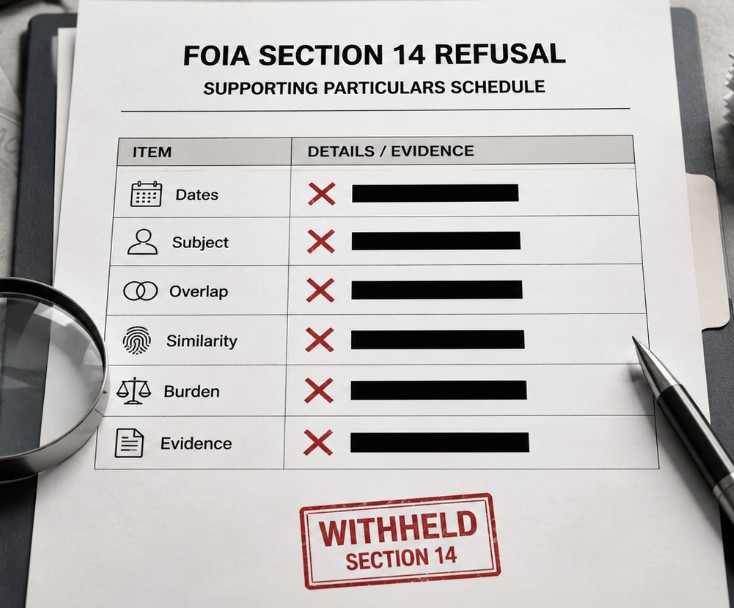
Recent police responses suggest these are not academic questions. A closer examination of three separate examples involving:

  • the National Police Chiefs’ Council,
  • Gwent Police, and
  • Staffordshire Police,

reveals a strikingly familiar structure: request volume asserted, particulars withheld, and different forms of correspondence blended into one wider burden narrative.

That matters. A Freedom of Information request, an Internal Review, a Subject Access request and a complaint are not the same thing. Each serves a different statutory or procedural purpose.

If they are blended together, the result can be a much larger and more damaging impression: the difficult requester, the repetitive applicant, the “bombardment”.

But without dates, subjects, categories and evidence of actual burden, that impression may be very hard to test.

This is not presented as proof of coordination or misconduct. It is a comparative note identifying notable parallels.

If section 14 is to be relied upon, the arithmetic should be transparent.
Read the full note here.

Similar Posts

  • 12. The Low Cost Check That May Save £1,000’s

    Buying a vehicle is often one of the largest purchases many people make outside of buying a home. Yet surprisingly little attention is sometimes given to verifying the vehicle’s history before the purchase takes place. In a market where stolen vehicles, cloned registrations and undisclosed loans or insurance write-offs circulate, a small amount of due…

  • 3. Who Helps The Innocent?

    Should the Original Police Force Normally Handle the Innocent Purchaser’s Crime? When a stolen vehicle is recovered from an innocent purchaser, responsibility for dealing with that purchaser’s position is often unclear. In some cases the buyer is directed to report fraud elsewhere or pursue civil remedies independently. Yet the innocent purchaser’s situation arises directly from…

  • 7. Investigation – Insurers vs. Police

    Vehicle theft claims are rarely accepted without scrutiny by insurers. On the contrary, insurers routinely examine the circumstances of a theft claim in considerable detail. They may analyse key histories, ownership records, financial arrangements, usage patterns and test a claimant’s account. This level of scrutiny highlights an interesting contrast: while insurers may conduct detailed investigations…

  • The Rise & Fall of Operation Igneous

    How the UK Tackled Car Crime and Let It Slip Away In the 1990s, the UK faced a tipping point in car crime. Manufacturer-led security innovations, such as transponder keys and advanced engine management systems, collided with record-high allegations of vehicle theft. During this pivotal era, one initiative promised a breakthrough: Operation Igneous. While hailed…

  • Which? … What?

    Criticism of car insurers who are ‘generally more reliable than other sectors for accepting customer claims: data from the Financial Conduct Authority (FCA) found that car insurers accepted 99 per cent of claims last year’, appears misplaced The Which? report can be accessed here with comments about: It is unfortunate that the substantial positives reflected…

Leave a Reply

Your email address will not be published. Required fields are marked *