Skip to content

Car Crime U.K.

Understanding Vehicle Theft

Menu
  • Vehicle Crime
    • ‘Form A Squad’ – Ineffective Action
      • The Vehicle Crime Task Force (VCT) – 2019
      • 2022 to 2023 National Vehicle Crime Working Group
    • Stolen Vehicle Recovery – Found in the U.K.
    • Stolen Vehicle Recovery – Found Abroad
    • OPERATION IGNEOUS – reducing reported car theft by 30%
    • Title Law
  • LoS* Data
  • Guidance / Help
    • Abbreviations & Terminology
    • Resources
      • Your Vehicle Theft Insurance Claim
      • Police Contact Emails
    • Links
  • Police Reports
    • Police Theft Reports
    • Police Collision Reports
    • Police Disclosure Delays
  • News
  • Policy & Research
  • Articles & Info’
    • The Freedom of Information Act
    • Subject Access Request (SAR)
  • Contact
Menu

DVLA Fraud – Inside the System

Posted on June 7, 2026June 8, 2026 by 5@mwosb.co.uk

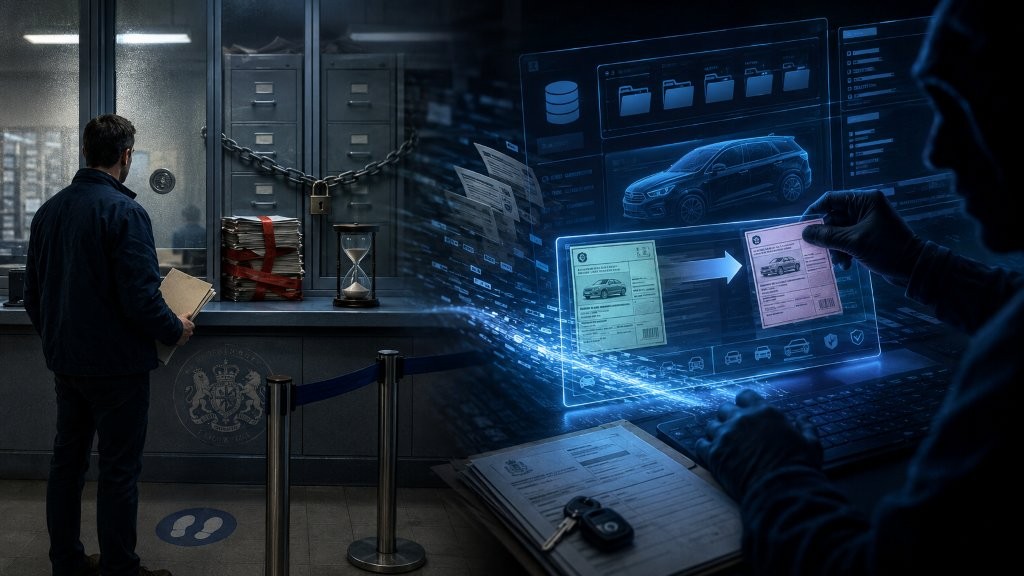
A former DVLA employee has been jailed after using his trusted access to alter vehicle records and documentation. This was not a minor paperwork offence.

Matthew Holloway manipulated DVLA records, obscured vehicle histories, created new V5C logbooks and helped increase vehicle values through falsified documentation.

That should concern everyone.

DVLA records are relied upon by buyers, traders, insurers, finance companies, provenance providers and police. They are part of the chain of trust that sits behind almost every vehicle transaction in the UK. When those records are manipulated from within, victims are created and trust is eroded.

The Bigger Question

This case should not be dismissed as one dishonest employee. The real questions are:

  • How was this possible?
  • How long did it continue?
  • How was it detected?
  • How many vehicles were affected?
  • How many innocent purchasers, insurers or lenders may have relied upon false information?
  • And what assurance now exists that similar manipulation cannot happen again?

DVLA has reportedly said internal controls have been strengthened. That is welcome. But given the importance of the records involved, the public is entitled to more than reassurance.

Lawful Access Remains Too Difficult

There is also an uncomfortable contrast.

While this corrupt insider was able to manipulate vehicle records, those lawfully trying to uncover vehicle fraud and dishonesty often face slow, onerous and restrictive processes when seeking information from DVLA.

Nobody is suggesting that keeper data should be freely available. It should not.

But vehicle crime has changed. Modern vehicle fraud can involve altered identities of vehicles and individuals, false V5Cs, write-off concealment, ringing, finance fraud, provenance manipulation, export issues and innocent purchasers being left with vehicles they may never legally own.

These are not simple “stolen car” cases. They are often complex, document-heavy frauds. Yet the lawful routes for obtaining relevant information can appear paper-driven, narrow and disconnected from the reality of modern vehicle crime.

DVLA Must Adapt

Police are overstretched. Many complex vehicle fraud cases require time, specialist knowledge and detailed document analysis. Where police cannot act quickly (if at all), lawful and proportionate access to relevant DVLA information becomes more important — not less.

The answer is not open access.

The answer is better access: audited, justified, proportionate and fraud-aware.

This case raises a simple but serious question:

Vehicle crime has changed. Has the DVLA adapted?

If official records can be compromised from within, while lawful efforts to expose fraud are obstructed from outside, the system is not protecting the public as well as it should.

Leave a Reply Cancel reply

Your email address will not be published. Required fields are marked *

Recent Posts:

  • When ‘Many Requests’ may not mean ‘Many Requests’
  • DVLA Fraud – Inside the System
  • NaVCIS – Industry-Funded Enforcement — But How, Exactly?
  • FoIA & AI: Formulating Better Requests, Not More Noise
  • Home Office Records Reveal NaVCIS Was “Working Month to Month”
  • Inside the NPCC’s FoI Referral Unit
  • 13. What Better Practice Would Look Like
  • Stolen in Britain, Sold Abroad
  • 12. The Low Cost Check That May Save £1,000’s
  • 11. Good Faith Is Not Enough
  • 10. The Power Imbalance
  • Collaboration or Endorsement? A Closer Look at NVCRP Engagement
  • 9. Trackers Do More Than Recover Cars
  • 8. The Theft to Recovery Timeline
  • 7. Investigation – Insurers vs. Police
  • 6. The Police (Property) Act:
  • 5. Moving the Vehicle Along – Disposal
  • Policy Question: Is Automated Weeding Necessary?
  • 4. Police Powers to Seize Do Not Decide Ownership
  • FOI Update: “Not Held” and the Question of Process
  • 3. Who Helps The Innocent?
  • Remote Technology and Stolen Vehicles
  • 2. The Innocent Purchaser
  • The ICO – running out of time?
  • 1. A Police Crime Report Is Not a Title Decision
  • The Problem With Crime Numbers:
  • When Recorded Theft Is Not Believed
  • NaVCIS Funding: Still No Specifics
  • Agreed Police disclosure procedures not followed
  • £50 for a Police Report Update?
  • Section 184 Data Protection Act 2018
  • Keyless Taking or Key Questions?
  • When ‘Sale or Return’ Goes Wrong
  • BBC Crimewatch ‘Car Cloning’
  • Keyless Vehicle Theft:
  • Accusations of Criminality
  • Thefts Down – Except for Newer Cars!
  • Increase Pre-Crush Retention Period to 28 days?
  • Reducing Vehicle Theft by up to 30%
  • ‘The Others’ … are you among them?
  • Vehicle Abandonments Raise Questions Over Theft Claims
  • The State of Vehicle Taking in the UK: A Crisis of Enforcement, Not Engineering
  • Keystone Krooks – but £1.4 million stolen!
  • 2024 Vehicle Theft – how well (or otherwise) did your constabulary perform?
  • Vehicle Crime. Is Police Language Bluring Facts?
  • Superficial Approach to Vehicle Taking Overlooked Organised Crime
  • Keyless Vehicle Taking – Really?
  • Accuracy & Consistency Required
  • Do we need new legislation?
  • A System Built on Blind Faith? The Flaws in Police Information Dissemination
  • Which? … What?
  • The Rise & Fall of Operation Igneous
  • Vehicle Taking – Quantity not Quality

Legal Disclaimer
The information provided on this website is for general informational purposes only and should not be considered legal advice. While we strive to ensure the accuracy and relevance of the content, laws and regulations change frequently, and the application of legal principles varies based on specific circumstances.

No Legal Advice
Nothing on this website constitutes legal, financial, or professional advice. You should not rely on the information provided here as a substitute for seeking qualified legal counsel. If you require legal advice or guidance, we strongly recommend consulting a licensed solicitor or legal professional.

No Liability
We make every effort to keep the information up to date and accurate, but we do not guarantee the completeness, correctness, or applicability of any content. We accept no responsibility or liability for any errors, omissions, or reliance placed on the information contained within this site.

External Links & Third-Party Content
Any external links or references provided are for convenience only and do not constitute endorsement. We are not responsible for the accuracy, legality, or content of any external sites or third-party materials linked from this website.

User Responsibility
It is the responsibility of all users to verify the accuracy and relevance of any information before relying upon it. If you have a legal issue, you should seek advice from a qualified professional relevant to your situation.

By using this website, you acknowledge and agree to this disclaimer. If you do not agree, you should discontinue use of the site immediately.

© 2026 Car Crime U.K. | Powered by Superbs Personal Blog theme