
For most members of the public, a Freedom of Information request is simple.
A question is asked.
A public authority answers — or refuses.
What sits behind that process is rarely seen.
Recent disclosures from the National Police Chiefs’ Council (NPCC), however, reveal something rather more structured operating within national policing: a central referral mechanism in which requester identities are retained, compared, analysed and used to support what the NPCC itself describes as a “joined up approach”.
At what point does coordinated FOI administration become requester monitoring?
That question deserves examination.
The National Police Freedom of Information & Data Protection Unit
Most police Freedom of Information requests are dealt with locally by individual constabularies.
But where a force receives a request it considers technically difficult, legally sensitive, repetitive or nationally relevant, it may refer the matter to the NPCC’s National Police Freedom of Information and Data Protection Unit (NPFDU), specifically its Central Referral Unit (CRU), for advice.
That, in itself, is not necessarily controversial. National consistency can be helpful.
What is more striking is what the NPCC’s own internal process documents say happens next.
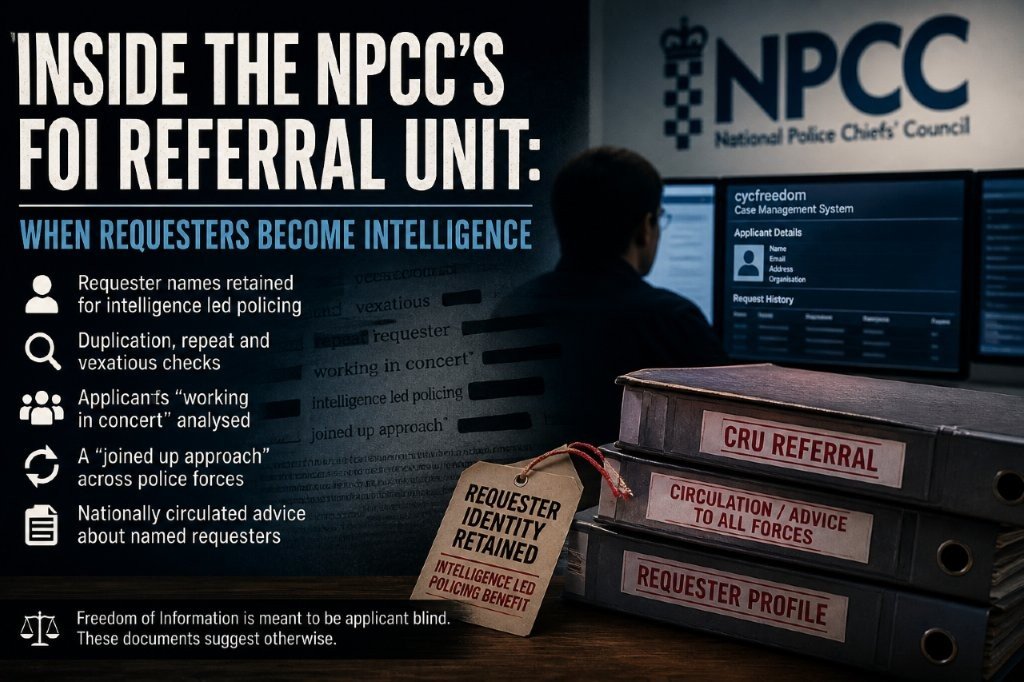
Disclosed guidance confirms that when a force refers a request, the CRU does not merely examine the wording of the question.
It collects and retains:
- the applicant’s name,
- email or postal address,
- organisational details,
- the wording of the request,
- and the referral history.
The NPCC expressly states that this information is used to check:
- duplication,
- repeat requests,
- vexatious considerations,
- and applicants “working in concert”.
In other words, requester identity is not incidental. It is part of the analytical model.
“The benefit to intelligence led policing outweighs removal”
One sentence within the NPCC’s February 2025 governance material is particularly revealing.
Having reviewed whether applicant names should continue to be retained on its case management system, the NPCC records:
“We have risk assessed the need to keep a record of the name on our case management system only, and feel the benefit to intelligence led policing outweighs removal at this time.”
That is an extraordinary phrase in the Freedom of Information context.
“Intelligence led policing” is language ordinarily associated with crime patterns, organised offenders and operational analysis. Here, it is being used to justify retention of FOI applicant identity.
The same documentation confirms that these requester details are entered onto the NPCC’s cycfreedom records management system and retained over multi-year periods.
This is not ad hoc email advice. It is a searchable national memory bank.
A joined up approach” to recognised requesters
The disclosed CRU process notes go further.
Applicant names are retained, the NPCC says, to identify requesters making similar approaches across police bodies and to ensure “a joined up approach”.
That phrase appears repeatedly across NPCC governance material.
- A joined up approach to what, exactly?
The answer appears to be: consistency of handling where a requester is recognised.
The NPFDU’s own Manual of Guidance states that the unit’s remit includes:
- proactively monitoring misuse of the legislation, and
- managing intelligence in relation to misuse of the legislation.
This is not merely legal signposting. It is an intelligence lens being applied to statutory information rights.
When the requester becomes the subject
The implications become sharper when read alongside separate Subject Access material disclosed by the NPCC. Within that disclosure is a document dated 25 June 2024 headed:
“Circular / Advice to all constabularies”.
The communication identifies this writer by name, states that the NPCC “suspect[s]” that requests are being kept private, and tells constabularies that if they receive similar requests the NPCC advice should be used “as a handrail”.
The substantive advice circulated nationally is almost entirely redacted. This raises an obvious difficulty.
The requestor can see that requester-specific commentary was being disseminated nationally, but cannot see what was actually said.
- What observations were made?
- What recommendations were given?
- What assumptions were recorded?
The same Subject Access material later reveals an internal NPCC requester-handling instruction issued in January 2025 setting out how requests from this writer, or similar applicants, should be interpreted and managed.
Taken together, the documents paint a picture that extends well beyond neutral subject-matter guidance. They suggest the emergence of a requester-recognition framework in which the applicant, not merely the request, becomes part of the handling exercise.
Why this matters
Some may ask “Why should this concern anyone other than a frequent FOI requester?”
Because Freedom of Information is intended to be applicant blind.
A public authority may consider burden, repetition and vexatiousness where lawfully justified, but the legitimacy of the system depends upon requests being judged on their substance – not quietly coloured by hidden institutional commentary concerning the person asking.
Once requester identities are retained nationally, compared for patterns, analysed for possible coordination, and circulated to ensure a “joined up approach”, a different question emerges:
‘is the authority still simply answering information requests, or is it beginning to build requester profiles?’
That distinction matters. It matters for fairness. It matters for transparency. And it matters because the public has no obvious visibility of what is being said internally when their names enter such a system.
The irony: the public record told a different story
One particularly revealing aspect of the June 2024 circular is the NPCC’s suggestion that requests were (somehow) suspected of being “kept private”. In reality, the requests in question were openly made on the WhatDoTheyKnow platform and visible to anyone.
It is that public FoI archive which now allows the chronology to be tested.
Without it, the requester would have little means of demonstrating whether such assumptions were accurate, inaccurate or entirely speculative.
The transparency provided by public FoI platforms may therefore have become the only effective counterweight to opaque institutional requester commentary.
Questions the NPCC now needs to answer
These disclosures raise several straightforward but important questions:
- Why are FOI applicant identities being retained under an intelligence-led policing rationale?
- How widely is requester commentary circulated across forces?
- What exactly constitutes “misuse of the legislation” intelligence?
- How often are requester-specific circulars issued?
- What safeguards exist to ensure requests remain genuinely applicant blind?
- And why is substantive commentary about identifiable requesters heavily withheld from Subject Access disclosure?
These are no longer abstract questions about administrative tidiness. They go to the heart of how nationally coordinated policing bodies understand – and potentially manage – members of the public who use statutory information rights persistently.
Regulatory scrutiny now engaged
The matters outlined above have now been placed before the Information Commissioner’s Office within ongoing complaints concerning both:
- the transparency of Subject Access disclosure, and
- the fairness of cumulative FOIA handling.
Senior NPCC management has also been asked to explain the provenance and rationale of the June 2024 national circular.
Those responses will matter. Because what is at issue here is not simply one requester’s disagreement with a refusal.
It is whether, behind the scenes, a national police FoI unit has quietly developed an intelligence-style requester monitoring architecture that the public was never expected to see.
Documents referred to in this article are held on file and have been provided to the Information Commissioner’s Office.
Related: