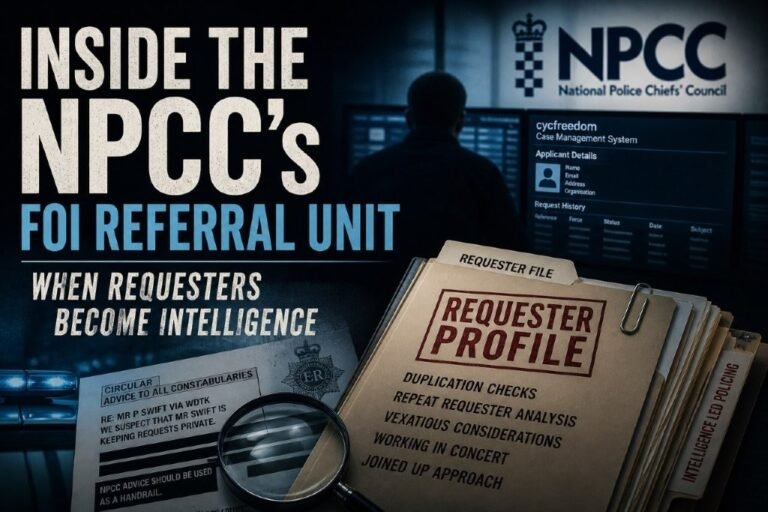
A Freedom of Information request submitted to Staffordshire Police in July 2025 has raised a broader procedural question about how requests are handled over time. The request was initially refused under section 14 (vexatious), maintained at internal review. Months later the response was revised, following ICO involvement, to a position that the information is ‘not…
Category: Car crime
3. Who Helps The Innocent?
Should the Original Police Force Normally Handle the Innocent Purchaser’s Crime? When a stolen vehicle is recovered from an innocent purchaser, responsibility for dealing with that purchaser’s position is often unclear. In some cases the buyer is directed to report fraud elsewhere or pursue civil remedies independently. Yet the innocent purchaser’s situation arises directly from…
Remote Technology and Stolen Vehicles
Capability Without Coordination? Modern vehicles are increasingly connected devices. Many can receive over-the-air updates, transmit diagnostic information, and in some cases be located remotely. This often leads to a simple question: At first glance the solution appears straightforward. In practice, the situation is more complicated. Manufacturers are rarely the first organisation to learn that a…
2. The Innocent Purchaser
The Forgotten Victim in Vehicle Recovery When a stolen vehicle is recovered, attention naturally turns to the original theft, to the person who reported the theft. Yet there is often another victim in the story: the innocent purchaser who bought the vehicle in good faith. That person may have paid a substantial sum of money,…
The ICO – running out of time?
A watchdog that cannot keep up risks turning a legal right into a theoretical one The Information Commissioner’s Office (ICO) has acknowledged that complaints may now take around 40 weeks simply to be assigned to a case officer. When added to the statutory process — 20 working days for a response and up to 40…
1. A Police Crime Report Is Not a Title Decision
When a vehicle is reported stolen, most people assume the legal position is straightforward: the vehicle belongs to the person who reported it stolen, and anyone found in possession of it must simply surrender it. In reality, the situation can be far more complicated. A police crime report records an allegation of theft, but it…
The Problem With Crime Numbers:
When Allegations Start to Look Like Evidence A crime reference number confirms that something was reported. It does not confirm that the crime actually happened. Yet within vehicle theft claims, crime numbers and PNC “Lost or Stolen” markers are often treated as if they validate the allegation. In a recent case, a police review concluded:…
When Recorded Theft Is Not Believed
In a recent case, a senior reviewing officer recorded doubt that a vehicle theft had occurred. The crime remains recorded. This is not about one force. It raises a wider issue: Crime reports and crime reference numbers confirm that an allegation was recorded. They do not confirm that the allegation was verified. In many cases,…
NaVCIS Funding: Still No Specifics
Recent Parliamentary Questions on the National Vehicle Crime Intelligence Service (NaVCIS) were intended to clarify how this body is funded and governed. The Government’s answer was familiar: ‘NaVCIS is funded by industry partners, including finance and leasing companies, insurers and hauliers’. However, this broad description raises as many questions as it answers. What remains unclear?…
Agreed Police disclosure procedures not followed
A recurring issue in vehicle theft cases is not recovery, but what happens afterwards. In a recent case, a stolen vehicle was recovered, albeit damaged and released by police on 5th January 2026, indicating that enquiries at the scene and forensic examination had been completed sufficiently to allow its return. A second vehicle stolen at…