The Intelligence Arrived. Then the Trail Went Cold.
What can happen when UK police receive information that a stolen vehicle may have been located overseas?
It began, as many investigations do, with something entirely unrelated. A stolen vehicle had supposedly been recovered by another police force. Except it had not.
The wrong vehicle had been identified.
The Police National Computer (PNC) Lost or Stolen marker had to be reinstated and the administrative error corrected. It was an interesting, intriguing mistake. I asked for an explanation.
Emails passed between police forces. One of those emails contained a surprising disclosure;
- From my understanding it appears the genuine vehicle has yet to be recovered and looks like from the telematic info provided on the Niche it is be (sic) currently in India*?
UK policing had previously learned of this through some form of location device.
*later being corrected to Pakistan.
At that point, the obvious question wasn’t how the vehicle had been located. It was…
What happened next?
The correspondence did not say. It did not explain where the information had originated. Nor did it identify the technology involved.
I simply do not know and I do not think it matters because by that stage the intelligence had already reached UK policing. The technology had done its part.
The real question was what happened after the information arrived.
I expected the answer to be straightforward.
- What had the recording constabulary done?
- What would they do?
- Had the insurer been informed?
- Had anyone been told who might realistically pursue recovery?
Instead, the questions disappeared into a Freedom of Information process that eventually lasted seven months.
The Internal Review eventually explained that national mechanisms exist for handling intelligence of this nature. It referred to intelligence-led decision making, operational assessments, the College of Policing, NaVCIS, the National Crime Agency and INTERPOL.
All of which sounds entirely sensible. Yet the one question that mattered remained unanswered.
What actually happened in this case?
The significance of the discovery is concerning:
I had only learned about the Pakistan intelligence because another police force had made an unrelated mistake. Had that error not occurred, had I not questioned why the Lost or Stolen marker had disappeared from the PNC, had the subsequent emails never been exchanged … I would never have known that information placing the vehicle in Pakistan had apparently been received.
This is difficult to ignore because it raises further questions:
- how many similar notifications have been received in other cases?
- what happened to them?
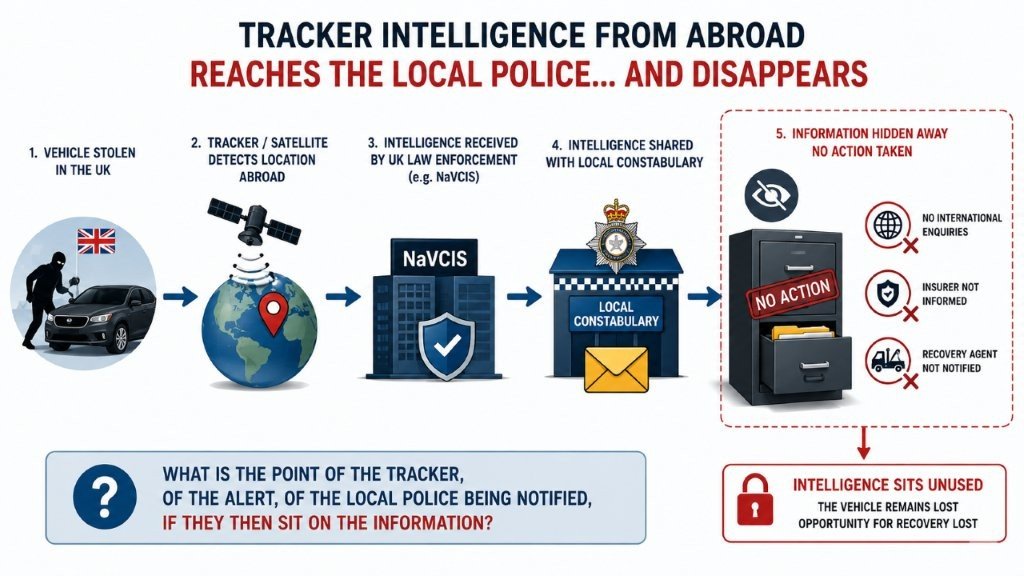
This is where the story stops being about one vehicle. Somewhere, a system capable of locating stolen vehicles appears to have generated information. Somebody considered it sufficiently credible to pass it into UK policing. Somebody decided the local constabulary needed to know.
That is not a trivial process. It suggests an intelligence chain that works remarkably well.
- Information is generated.
- Information is assessed.
- Information is communicated.
And then…
The trail appears to end. Not because the vehicle disappeared. But because nobody has yet explained what happened after the intelligence reached the local police.
That distinction matters. This article is not about whether the police should recover every stolen vehicle themselves. Nor is it about whether every overseas notification should trigger an international operation.
Reasonable people may disagree about what action is proportionate in any individual case. But there are more fundamental questions.
- If intelligence indicating that a stolen vehicle has been located overseas reaches UK policing, who is responsible for deciding what happens next? If no action is appropriate, who records that decision?
- If another organisation should take over, who tells them?
- If the insurer or recovery specialists are expected to play a role, how can they possibly do so if the intelligence is never communicated?
Recovery cannot rest with those who never receive the information.
The Freedom of Information process has now revealed that national mechanisms exist. What it has not revealed is whether those mechanisms were used here. Nor has it explained what became of the intelligence once it reached the local constabulary.
That leaves a governance question which extends far beyond one force and one stolen vehicle.
It affects every manufacturer investing in connected vehicle technology. Every insurer funding vehicle recovery initiatives. Every owner who believes technology improves the prospects of getting their property back. And every police force receiving intelligence that may present an opportunity to recover stolen property.
The original Freedom of Information request is now before the Information Commissioner’s Office.
A further request has been submitted seeking information about how frequently UK police receive intelligence indicating that stolen vehicles have been located overseas, what action follows, whether that information is shared with those capable of pursuing recovery, and how those decisions are made.
Because this can no longer be dismissed as an isolated curiosity. It raises fundamental questions about how intelligence is used.
I keep returning to one simple chain of thought.
- Somebody, somewhere, invested considerable effort in developing technology capable of locating stolen vehicles.
- Somebody built systems capable of recognising that information.
- Somebody decided it was important enough to pass into UK policing.
- Somebody decided the local constabulary needed to know.
Why?
If the information simply stops there, if nobody outside policing is aware that it exists, if no explanation is ever given as to what happened next?
The issue isn’t whether Leicestershire Police should have recovered a vehicle from Pakistan. The issue is what happens when the force that receives the intelligence decides it will take no further action.
- Does the intelligence stop there?
- Or does somebody else become responsible?
Because if the answer is that nobody becomes responsible, then we are left with an uncomfortable question.
Why generate, assess and distribute the intelligence in the first place?
Perhaps that is the wrong question. Perhaps the better one is this.
When intelligence indicating the location of stolen property reaches UK policing, where does responsibility begin… and where does it end?
Until that question can be answered, it is difficult to understand whether the system is recovering stolen vehicles or simply collecting information about where they are.
I have received one clear answer. Leicestershire Police explained their position as follows:
- “As far as we’re concerned, we have no further lines of enquiry to be recovering that vehicle, and we wouldn’t recover that vehicle.
- It’s outside the UK. In terms of our investigation – it is closed.
- We won’t be doing anything further with it.”
That is an understandable position if viewed purely as a local criminal investigation. A constabulary cannot reasonably be expected to recover every vehicle reported to be abroad. But that is not the question this case raises.
The more difficult question is this:
- What happened to the intelligence once the constabulary decided it would take no further action?
- If the investigation was closed locally, was the information passed to anyone else?
- Was the insurer informed?
- Were recovery specialists notified?
- Was the organisation that generated the intelligence advised?
Or
- Did the information simply remain within policing systems because the local investigation had ended?
Editor’s note:
This article concerns the handling of intelligence indicating that a stolen vehicle may have been located overseas. It does not suggest that Leicestershire Police were under an obligation to recover the vehicle themselves. Rather, it asks what happens to such intelligence once a local force decides it will take no further operational action, and whether it should be communicated to others capable of pursuing recovery.
This article is based on correspondence and Freedom of Information requests currently in the public domain.
For readers wishing to examine the primary documents, they can be found at:
- Original Freedom of Information request (WhatDoTheyKnow) to include the Internal Review correspondence and outcome
- Further Freedom of Information request concerning overseas vehicle-location intelligence
The original request is currently the subject of a complaint to the Information Commissioner’s Office.