Stolen Vehicles Are Disappearing From National Records — But Who Wants to Know How Many?
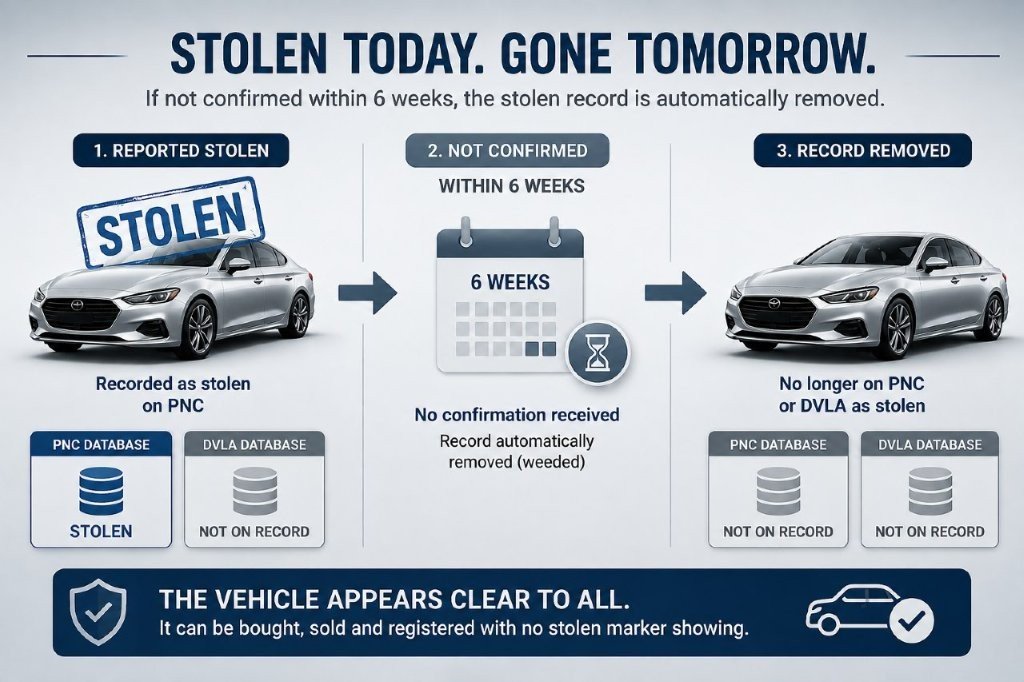
A stolen and still-outstanding vehicle can cease to be recorded as stolen on the Police National Computer (PNC) simply due to a police admin oversight – a failure to ‘CONFIRM’ the crime allegation. The result:
- After six weeks, the Lost/Stolen (LoS) marker is automatically “weeded” is removed from the PNC LoS register… it is no longer recorded as ‘stolen’.
And, as never ‘confirmed’, the DVLA was never notified of the theft either.
The result is extraordinary: a stolen vehicle can appear clear on both systems – and potentially be acquired by, registered to, an innocent purchaser.
We now know the problem is real
This is no longer theory. The National Audit Office (NAO) examined the issue, spoke directly with the Home Office and wrote under the heading:
“POTENTIAL SYSTEMATIC UNDER-RECORDING OF STOLEN VEHICLES”
The Home Office confirmed that the weeding process causes a difference between police and DVLA stolen-vehicle records.
Analysis of 2025 data found that difference to be at least 20,282 records — 18.83% — increasing to 28,258 records, or 24.42%, using the wider police dataset.
That does not mean 20,282 vehicles were wrongly weeded. It does mean there is a very large gap, weeding is a confirmed contributor to it, and nobody has yet established publicly how much of that gap represents genuinely stolen vehicles which should still be recorded as stolen.
So how many are there?
That is the question I have been trying to answer.
PNC’s VE602/VE602J process provides police with a reminder where vehicle theft reports remain unconfirmed and ultimately removes those which remain unconfirmed at six weeks. The process also generates statistics. Those statistics could help reveal the scale of the problem.
I asked the Home Office. They confirmed that VE602J reports are generated and archived, but declined to provide the information, maintaining that it is held on behalf of police forces. On 29 July 2026, the Home Office suggested that the National Police Chiefs’ Council (NPCC) might be able to assist.
I approached the NPCC that same day. Seven days later, the NPCC refused my request under section 14 of the Freedom of Information Act: vexatious requests.
Part of its reasoning? I have made too many previous requests concerning stolen vehicles.
There is an uncomfortable irony
The NPCC has known about the weeding problem for some time. It has previously issued national communications intended to address it.
The Home Office knows about it.
The NAO investigated it and obtained important confirmation, but has said they
“do not intend to conduct further work on this matter at this time.”
The Home Office is considering whether the confirmation requirement should eventually be removed from LEDS, but there is no timetable.
And when I approached the NPCC seeking information which might help quantify the present problem, the request was refused as vexatious. So the question remains:
How many stolen vehicles are no longer recorded as stolen because somebody failed to confirm their LoS record?
And perhaps the more disturbing questions:
- How many now have new registered keepers?
- How many are in the hands of innocent purchasers?
- How many opportunities to recover them have already been missed because PNC, DVLA or vehicle-provenance enquiries returned no stolen marker?
Nobody presently appears able – or willing -to provide the numbers.
If I have asked too many times, what has been done about the problem?
That is the particularly uncomfortable aspect of the NPCC’s section 14 decision.
If the issue has indeed been brought to its attention repeatedly:
- why does nobody appear to know its scale?
- why has the issue not been addressed?
I have therefore sought an Internal Review of the NPCC decision, which, with the chronology and supporting evidence, can be read here.
The police (PNC) and DVLA stolen vehicle data information & comparision.
The relevant timeline:
- 05/01/2026 – A report: Has ‘weeding’ caused 1,000’s of stolen vehicles to not be recorded as such on the PNC or at the DVLA?
- 25/06/2026 – NAO reports Home Office confirmation of weeding issue
- 30/06/2026 – Request of the Home Office for information [8937 – clarification]
- 03/07/2026 – FoIA request of the Home Office for VE602 information [9165]
- 29/07/2026 – Home Office [8937] points to the NPCC & in response to 9165
- 29/07/2026 – the NPCC was approached for ‘National Governance and Assurance of VE602 / VE602J Vehicle Weeding Reports‘
- 05/08/3-36 – NPCC refuses under s.14 – local text here
- 09/08/2026 – Internal Review request submitted