
A problem acknowledged — but how big is it?
On 05/01/2026 I submitted detailed material to the Home Office and others setting out my concern about six-week ‘weeding’ in the form of a summary, ‘The Extent of Weeding‘ and a more detailed report.
The basic process is now reasonably clear:
- vehicle Lost or Stolen (LoS) markers placed on PNC are initially unconfirmed;
- only confirmed markers are included in information provided to DVLA;
- unconfirmed markers are removed from PNC after six weeks.
The consequence is potentially significant.
If a genuinely stolen vehicle remains unconfirmed and is then weeded, its stolen status may no longer appear on PNC and may never have reached DVLA through that data flow.
The concern was not merely statistical. If a stolen marker disappears, opportunities for recovery, investigation and warning subsequent users of vehicle information may disappear with it.
I then tried to establish the extent of this problem.
- How many stolen vehicles were not recorded stolen due to this admin issue?
As one indication, I compared the number of vehicles recorded by police as Lost/Stolen with the number of Lost/Stolen notifications received by DVLA. I obtained the data, analysed it and provided a constabulary-by-constabulary analysis.
Subject to differences in the way police data is recorded, the gap appeared to be somewhere between about 20,000 and 28,000 vehicles in 2025 alone. That does not mean all of that difference is caused by weeding. There are legitimate reasons why police and DVLA figures will not match exactly.
The question was therefore: how much of the difference is attributable to unconfirmed records being weeded?
There was a lack of engagement to my 05/01/2026 submission. I therefore approached the NAO:
- 28/05/2026 – I wrote to the National Audit Office (NAO)
- 25/06/2026 – the NAO responded; a known problem according to the Home Office
That was an important development. What had begun as a concern arising from individual cases and data analysis was now supported by an official explanation of the national process.
My attention then turned to VE602/VE602J – the PNC process which produces reminders about records approaching weeding. I sought information from the Home Office.
- 29/07/2026 – Home Office response – the National Police Chiefs’ Council may be able to assist you.
- 29/07/2026 – NPCC request regarding the ‘National Governance and Assurance of VE602 / VE602J Vehicle Weeding Reports‘
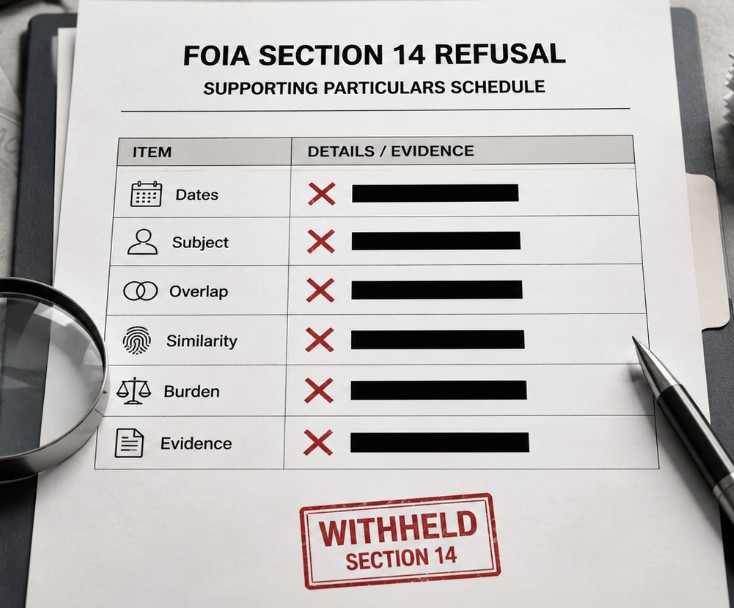
- 05/08/2026 – The NPCC response – they refuse to disclose the information citing various aspects amounting to ‘s.14 -vexatious’
- 09/08/2026 – an Internal Review is submitted challenging the NPCC’s statements.
- 02/09/2026 – The NPCC’s Internal Review – they maintained section 14, but materially qualified a number of aspects of the original refusal. Amongst other things, the review accepted that:
- not every reference relied upon represented a separate originating FOIA request;
- some were Internal Reviews, ICO complaints or subsequent correspondence;
- the VE602 request differed in wording from earlier requests;
- it arose after the Home Office directed me towards NPCC;
- my concerns have a genuine public-interest element;
- my motive was not malicious or intended to harass;
- the request itself was courteous; and
- the original refusal had “perhaps overstated the degree of similarity” with the request currently before the Information Tribunal
The review also expressly said:
- “Nothing in this review concludes that your concerns are frivolous…” and
- acknowledged that vehicle-theft recording “plainly is” important.
Yet the request remained refused because the NPCC considered the cumulative history of my engagement on interconnected vehicle matters disproportionate.
Further correspondence followed:
- 03/09/2026 – Response to the NPCC raising questions, seeking clarification
- 03/09/2026 – NPCC response -‘not prepared to enter further correspondence ‘
- 03/09/2026 – Concerned the NPCC declines to answer pertinent questions about their conduct.
- 03/09/2026 – The matter was reported to the ICO.
So where does that leave the underlying issue?
That position is unusual.
The NPCC’s Internal Review accepts that the issue is not frivolous and has a genuine public-interest dimension. It also materially qualified parts of the reasoning relied upon in the original refusal. But I still do not have the information needed to answer the central question:
How big is the problem?
I work professionally in vehicle crime. It is therefore unsurprising that many of the information-rights questions I ask concern vehicles.
The difficulty is that the NPCC’s present approach allows different matters within that specialist field to be treated as interconnected when section 14 is considered.
The practical effect is that FOIA is becoming increasingly difficult to use, as per this example, to establish the scale of an issue which the NPCC itself accepts has substance.
11 September 2026 — taking FOIA out of the equation
So today I have changed approach. I have written directly to the NPCC outside the Freedom of Information process and asked that the matter be considered as an operational and public-interest issue.
I am not asking anyone to accept my conclusion. I am asking for assistance obtaining the information needed to determine whether there is a conclusion to reach.
The immediate questions are straightforward:
- How many stolen-vehicle records reach the VE602 warning stages because they remain unconfirmed?
- How many remain unconfirmed at six weeks?
- How many are ultimately removed from PNC?
- What happens to those vehicles afterwards?
- Is the process subject to any national audit or assurance?
Those figures matter. If they show that only a negligible number of genuinely stolen vehicles reach final weeding, that would provide important reassurance.
If they show a material number, that would justify further examination.
Until the numbers are known, nobody can sensibly determine whether this is a minor administrative anomaly or a significant weakness in the national stolen-vehicle record.
The question is no longer whether the mechanism exists. It is why establishing its scale is proving so difficult.
But if nobody measures what is being weeded from the system, nobody has to explain the consequences.