NaVCIS – Industry-Funded Enforcement — But How, Exactly?
Recent Parliamentary Answers on the National Vehicle Crime Intelligence Service (NaVCIS) confirm that it is not funded by Government, but by “industry partners including finance and leasing companies, insurers and hauliers.”
That sounds reassuring. But what does it actually mean?
The Missing Detail
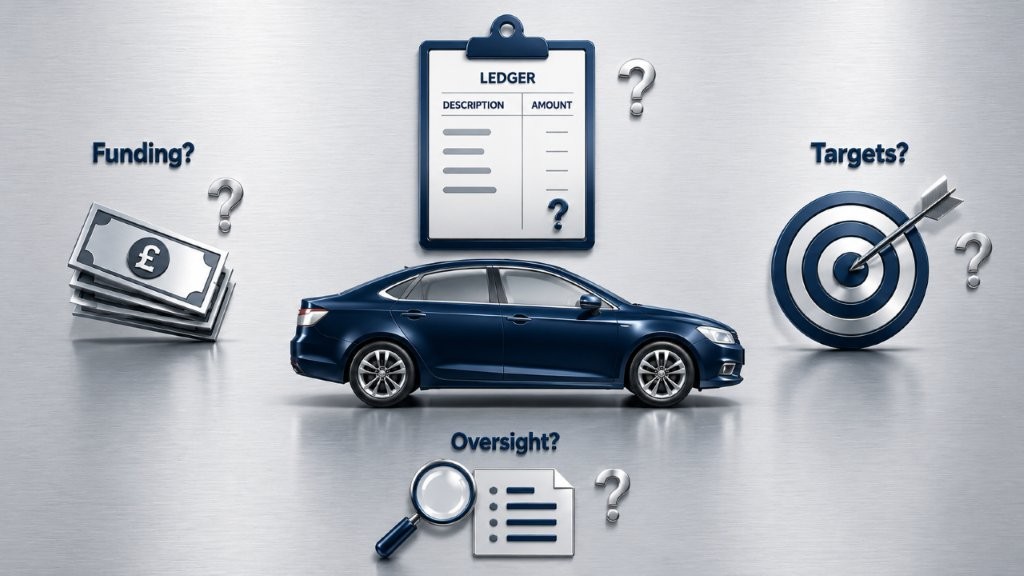
The answers do not specify:
- The proportion of funding from each sector.
- Whether funding is routed through a single industry body.
- Whether remuneration is linked to operational outcomes such as vehicle seizures.
- Whether fixed payments or value-based percentages form part of the model.
- What formal oversight exists where funding is linked to recoveries.
Those omissions matter.
Incentives and Enforcement
Where a body participates in vehicle recovery activity and its funding is connected — directly or indirectly — to recovered assets, questions naturally arise about incentive alignment.
Even if entirely lawful, an outcome-linked funding structure:
- may influence operational prioritisation,
- may affect resource allocation,
- and may raise legitimate governance questions.
These are structural questions — not accusations.
Status and Transparency
NaVCIS is frequently described as a “national policing unit.” However, it is not a police force and does not exercise independent police powers. Operational action ultimately rests with local constabularies.
That makes transparency around funding and governance all the more important.
If the model is straightforward, clarity should be easy. If funding is diversified across multiple sectors, that too should be confirmable.
At present, the public position remains general, not specific.
Why This Matters
Vehicle crime affects:
- victims,
- freight operators,
- insurers,
- finance companies,
- and — critically — innocent purchasers, amongst others.
Where enforcement structures intersect with private funding, public confidence depends on openness.
FOIA requests are ongoing.
The questions are simple:
Who funds NaVCIS, precisely?
- How is that funding structured?
- Are payments linked to outcomes?
- What safeguards exist?
Until those are answered clearly, the debate remains unfinished.
Further reading:
- Parliament responses to questions about NaVCIS
- 11/02/2026 – Governance of NaVCIS Funding Model
- 26/02/2026 – NaVCIS Funding: Still No Specifics
27/05/2026 – A complaint was presented to the NPCC.